The Mechanics of Dark Roast Coffee: Matching Roast Profiles to Brewing Methods
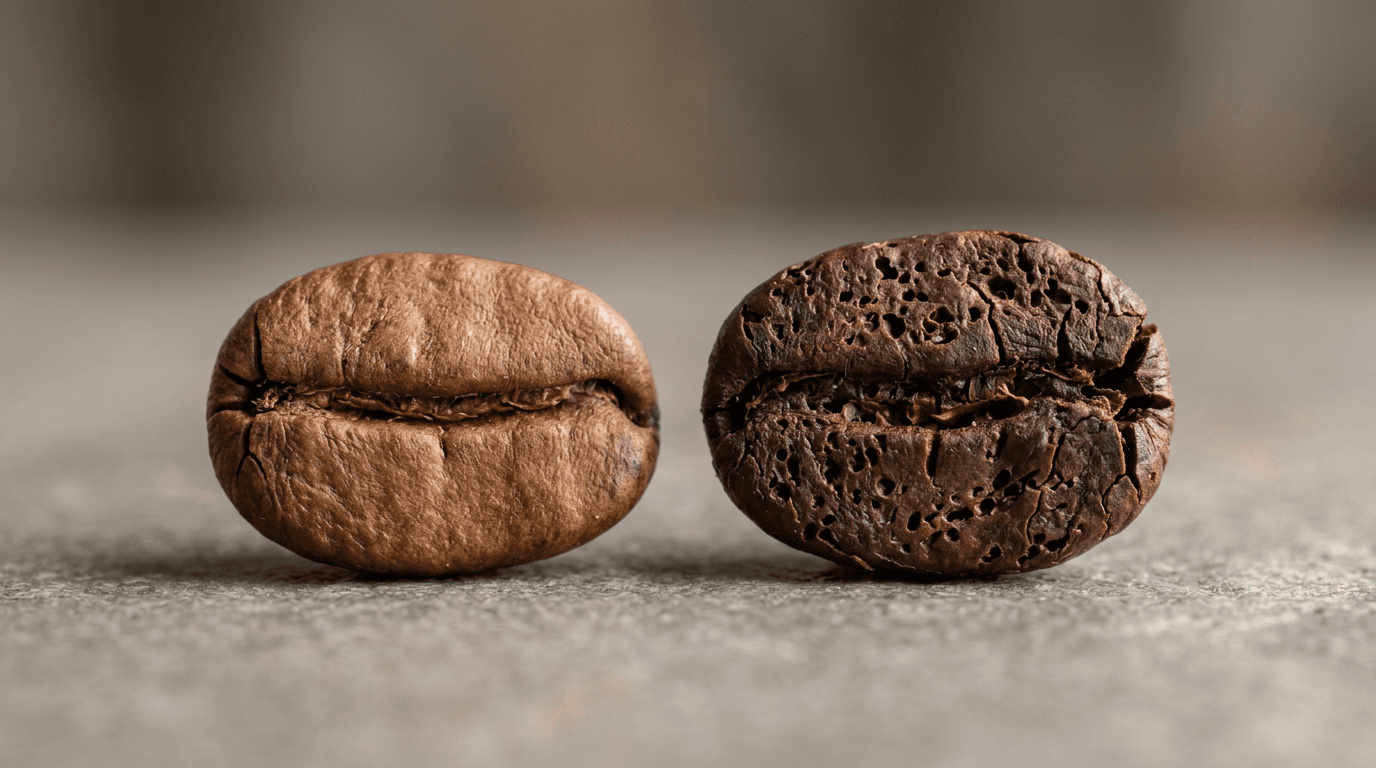
The moment a puck of light-roasted Ethiopian Yirgacheffe shatters under nine bars of pressure, channeling water aggressively through the basket and yielding a sharply acidic shot, the limits of extraction become visible. The pressure was correct, the yield standard, but the extraction failed because the variable was never the machine - it was the cellular density of the bean itself. Lightly roasted beans resist water intrusion in ways that short-contact methods cannot overcome without extreme temperature and pressure manipulation. Understanding how a dark roast coffee behaves fundamentally differently in the brewing basket compared to a lighter profile changes how you calibrate your grinder, program your boiler, and approach your daily brew.
Quick Summary
Matching your roast profile to your brewing apparatus is a mechanical exercise in managing cellular solubility. Because roasting breaks down the structural matrix of the seed, darker profiles dissolve rapidly in water, making them highly suited to short-contact, high-pressure, or lower-temperature environments. Conversely, light roasts retain their dense cellular walls and demand extended contact time or higher thermal energy to extract properly.
- Darker roasts are brittle, highly porous, and aggressively soluble.
- Lighter roasts are incredibly dense, resist water absorption, and require higher brewing temperatures.
- High-pressure methods rely on rapid solubility to fully extract compounds in under thirty seconds.
- Immersion methods require precise temperature control to prevent over-extracting porous, highly developed beans.
Table of Contents
- How cellular density governs dark roast coffee extraction
- Where high pressure demands specific solubility
- How degassing timelines alter your dialing-in process
- Why origin characteristics fade under extended heat
- What breaks when you swap filter profiles into an espresso basket
- The mismatch between dense beans and low-agitation brewing
- Comparison Table: Roast profiles across key dimensions
- FAQ
- Recommended Reads
How cellular density governs dark roast coffee extraction
During the roasting process, thermal energy rapidly expands the trapped moisture inside the raw green seed, generating intense internal pressure that eventually fractures the rigid cellular walls. The longer this destructive process continues, the more porous the resulting structure becomes. A high-grown dark roast arabica coffee maintains structural integrity slightly better than lower-elevation varieties due to its initial density, but it still emerges from the cooling tray vastly more brittle than a bean dropped immediately after the first crack.
This structural brittleness dictates exactly how the bean interacts with your grinder's burr geometry. Dense, lightly roasted beans tend to shatter into a wide spectrum of particle sizes, whereas brittle, highly developed beans crumble more uniformly but produce a distinct profile that packs tightly in a filter basket. When water hits this highly porous bed, it encounters almost no physical resistance at the cellular level. The soluble compounds - caramelized sugars, lipids, and Maillard reaction byproducts - wash out almost instantly into the cup.
Many roasters intentionally develop specific blends specifically to balance out these structural extremes, combining highly soluble components with slightly denser beans to create a predictable extraction rate that does not overwhelm the brewer. Without this structural balance, highly soluble beans run the risk of over-extraction the moment the water contact time is extended.
Where high pressure demands specific solubility
Espresso is a violent, accelerated brewing method. Nine bars of atmospheric pressure force water through a compacted puck of finely ground coffee in under thirty seconds. There is absolutely no time for gentle saturation or extended steeping. The pressurized water must rapidly penetrate the cellular walls and dissolve the available solids before flow channeling occurs.

This precise mechanical requirement is exactly why dark roast espresso beans remain the dominant, undisputed standard for commercial pump-driven machines. The extreme internal porosity of an espresso roast coffee allows the pressurized water to access and dissolve the necessary compounds within that strict twenty-five-second window. If the bean were less developed, the rapid contact time would only dissolve the fastest-extracting compounds - primarily volatile organic acids - resulting in a sharply sour, severely under-extracted cup.
Practical rule: Lower your machine's PID temperature by 2 to 3 degrees Celsius when switching from a dense, light roast to a highly developed dark roast to prevent over-extracting bitter, ashy compounds.
Relying on a classic African Espresso profile provides the necessary solubility for rapid, high-pressure extraction while still preserving enough intrinsic acidity to balance the heavy chocolate and caramel notes generated by the extended roasting process. The standard espresso extraction curve requires rapid solubility during peak pressure; extending the pump time past thirty seconds with these porous profiles only strips the harshest dry distillates out of the grounds.
How degassing timelines alter your dialing-in process
The development of deep roast profiles generates a massive volume of carbon dioxide inside the bean's structural matrix. While all freshly roasted coffee off-gasses over time, the highly fractured cellular structure of a deeply developed roast allows this gas to escape at a vastly accelerated rate compared to a dense, lightly roasted seed.
Carbon dioxide is not merely a benign byproduct of the roasting drum; in the brewing context, it acts as a highly effective physical barrier against your brew water. When hot water makes contact with a freshly roasted, highly developed bean, the sudden heat causes the trapped CO2 to rapidly expand and violently exit the cellular matrix. This localized outgassing physically pushes the water away from the bean's surface, completely halting the hydrolysis required to extract flavor.
If you attempt to brew deeply developed coffee within forty-eight hours of it leaving the roaster, this remaining internal CO2 violently repels the water. In an espresso machine, this manifests as massive channeling and erratic pump pressure. A deeply developed profile requires an accelerated but strictly observed resting phase. While a light roast might need up to twenty-one days to settle and become extractable, deeply developed beans typically hit their peak extraction window between day five and day ten. Following this window, the rapid off-gassing invites oxygen into the empty cellular spaces, severely accelerating lipid oxidation and staling.
Why origin characteristics fade under extended heat
Terroir refers to the specific environmental conditions - soil composition, localized elevation, and micro-climate - that give a green coffee lot its distinct flavor profile. These characteristics physically manifest as volatile organic acids and delicate floral or fruit esters. Under extended thermal exposure, these delicate compounds undergo Strecker degradation and complete structural breakdown. The longer the bean remains in the roasting drum, the more these origin-specific acids evaporate, replaced entirely by the heavy, caramelized sugars created by the Maillard reaction.
The elevation at which the coffee was cultivated determines its initial density long before it is exposed to heat. High-altitude environments force the coffee cherry to mature slowly, creating an incredibly dense, tightly packed cellular structure. A strictly high-grown Ethiopian lot possesses the density required to survive high heat, but its primary value lies in its fragile aromatics. Pushing such a delicate bean into the second crack destroys the exact acids that make it valuable.
Conversely, coffees grown at lower altitudes or processed via traditional wet-hulling possess a looser cellular matrix from the start. A wet-hulled dark roast sumatra coffee, for example, successfully carries its heavy, earthy body and low intrinsic acidity through the aggressive roasting process, resulting in a rich, syrupy extraction that maintains its identity even when highly developed. If you prefer exploring vibrant single origin lots, you must align the roast depth with the specific structural strengths and chemical limitations of the region.
What breaks when you swap filter profiles into an espresso basket
Consumers routinely assume that roast profiles are interchangeable across brewing equipment, leading to frustrating and expensive hardware adjustments when the actual failure point is simply the bean's cellular density. If you typically purchase highly soluble dark roast coffee beans for espresso but decide to load a lightly roasted filter profile into your hopper, your standard grind setting will immediately fail.
The dense, lighter bean offers significantly more physical resistance to the grinder burrs. The grinder will produce far fewer microscopic fines, creating a vastly more permeable puck in the basket. When the pump engages, the pressurized water will blast through this permeable bed in fifteen seconds instead of thirty, yielding a thin, aggressively sour shot lacking any body or sweetness.
To counteract this, the barista must grind significantly finer to artificially create the flow resistance that the bean's natural density lacks. This finer grind then requires higher brewing temperatures - often pushing past 95 degrees Celsius - just to force the water to dissolve the stubborn cellular walls. Beyond grinding finer, successful extraction requires extended pre-infusion, holding the puck at three bars of pressure for up to fifteen seconds simply to force water into the rigid cellular walls before applying full pump pressure. Attempting this on a standard boiler lacking flow control guarantees an unbalanced extraction.
The mismatch between dense beans and low-agitation brewing
Immersion brewing methods, such as the standard French press or traditional cold brew, rely entirely on contact time and ambient temperature to extract flavor. There is no mechanical pump forcing water through the grounds, and gravity plays a minimal role in the actual dissolution of solids. Because there is virtually no agitation, the water must passively penetrate the ground particles.
If you use a dense, light-roasted bean in a standard immersion setup, the coarse grind required for the metal filtration combined with the bean's structural resistance means the water struggles to access the inner matrix. The result is consistently a weak, grassy extraction, unless the steep time is drastically and impractically extended.
For those who prefer low-agitation methods, leaning on a highly developed 6 Bean Blend ensures that the water can easily saturate the porous grounds and extract a full-bodied cup without requiring mechanical force. Cold water possesses a fraction of the kinetic energy of boiling water, drastically reducing its efficiency as a solvent. For individuals seeking extreme convenience while maintaining fresh extraction parameters, using sealed 12 pack single serve coffee capsules entirely eliminates atmospheric oxygen from the equation prior to brewing, preserving the delicate aromatics and heavy lipids that rapidly degrade when highly soluble pre-ground coffee sits exposed in a hopper.
Comparison Table: Roast profiles across key dimensions
| Specification | Light Profiles | Medium Profiles | Dark Profiles |
|---|---|---|---|
| Cellular Density | Highly dense, resists water | Partially broken down, balanced | Highly porous, brittle |
| Solubility Rate | Slow | Moderate | Extremely rapid |
| Ideal Brew Temp | 93°C - 96°C | 90°C - 93°C | 85°C - 89°C |
| Degassing Window | 14 to 28 days | 7 to 14 days | 5 to 10 days |
| Primary Risk | Under-extraction (sourness) | Flatness if poorly dialed in | Over-extraction (ash, bitterness) |
FAQ
Why does my espresso pull drastically faster when I change to a lighter bean?
Lighter beans are physically denser and fracture differently in the grinder burrs, often producing fewer microscopic fines than brittle, porous beans. This lack of fines drastically reduces the physical restriction in the filter basket, allowing pressurized water to flow through much faster unless you significantly tighten your grinder adjustment to compensate.
Can I use highly developed profiles in a pour-over setup?
Yes, but the rapid solubility of deeply developed beans means you must fundamentally adjust your variables to prevent astringency. You should utilize a slightly coarser grind than usual, lower your water temperature to around 85 degrees Celsius, and minimize aggressive agitation during the pouring phases to prevent pulling out bitter tannins.
Why do heavily developed beans appear oily in the hopper?
Extended exposure to high temperatures inside the roasting drum breaks down the internal cellular walls of the bean completely. This severe structural collapse forces the seed's internal lipids and oils to migrate outward to the exterior surface, which is why highly developed beans leave a visible, sticky residue on grinder burrs and hoppers.
Does the roasting depth fundamentally alter the caffeine content?
While extreme heat does marginally degrade caffeine molecules, the chemical difference per bean is strictly negligible. However, because highly developed beans lose significantly more water weight, they physically weigh less per seed. If you dose your daily brew by volume using a scoop rather than mass using a digital scale, you are actually brewing fewer total beans and therefore extracting slightly less total caffeine.