How to Brew Vietnamese Coffee and Regional Cafe Styles at Home
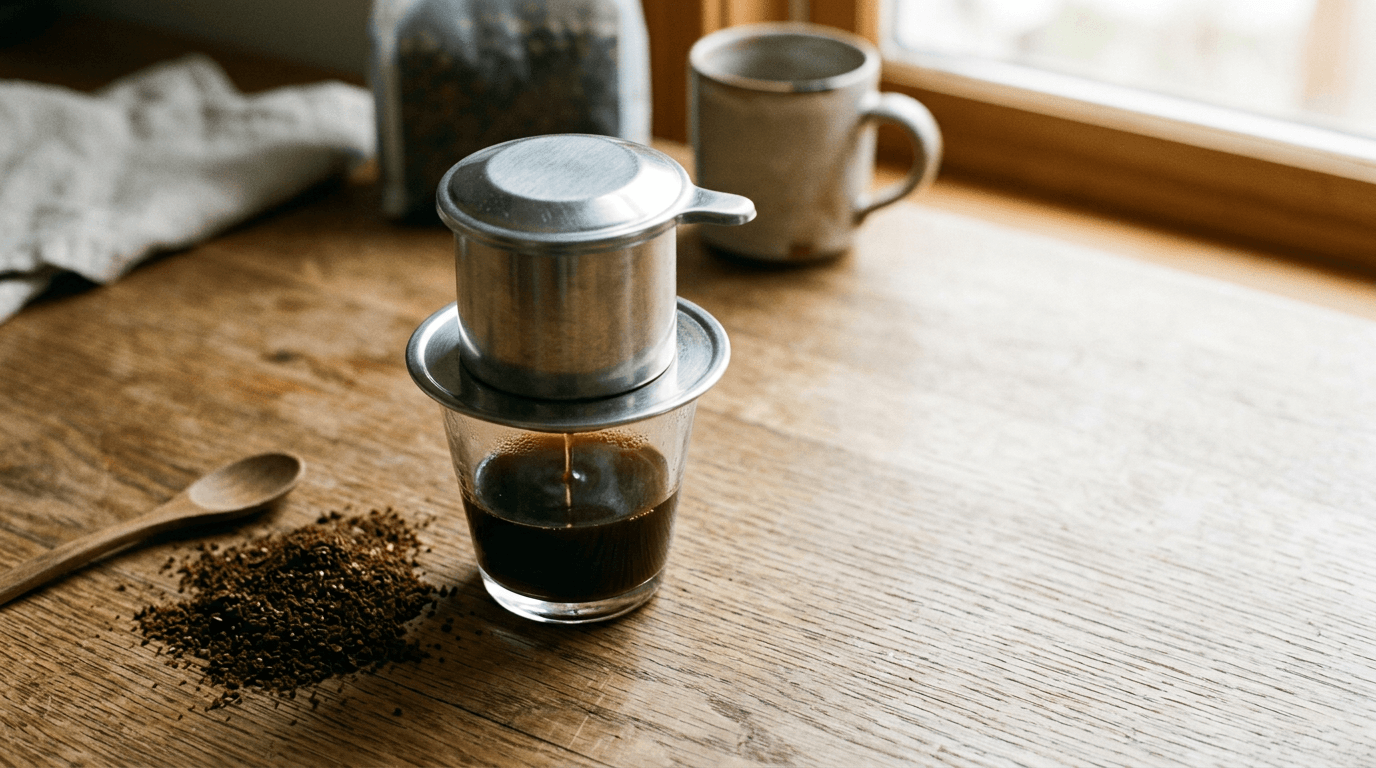
Most home brewers assume that learning to brew vietnamese coffee or replicate a complex Japanese drip requires expensive commercial machinery. They buy a costly pump espresso machine, only to find they still cannot match the heavy, syrupy texture of a Hanoi street stall or the crisp, floral acidity of a Tokyo kissaten. Regional coffee variations rely entirely on extraction mechanics - gravity, temperature shock, slow-drip diffusion, and vapor pressure - rather than mechanical force. Mastering these distinct styles means focusing on water chemistry, precise thermal management, and exact grind distributions instead of upgrading your equipment.
Quick Summary
Mastering regional coffee variations requires shifting focus from standard drip machines to specialized extraction mechanics like temperature shock, gravity percolation, and vacuum pressure. By controlling water chemistry, grind distribution, and thermal variables, home brewers can consistently replicate complex international flavor profiles without relying on commercial-grade pressure equipment.
- Use a stainless steel phin and precise plate tension for authentic Vietnamese coffee.
- Flash-chill hot extractions directly over ice to lock in volatile aromatics instantly.
- Manage decreasing static head pressure continuously when executing slow Kyoto-style cold drip.
- Control vapor pressure and limit draw-down agitation for clean siphon extraction.
Table of Contents
- 1. How to brew vietnamese coffee with a phin filter
- 2. Executing japanese cold brew coffee techniques
- 3. Setting up cold brew coffee Kyoto towers
- 4. Harnessing vapor pressure for siphon coffee
- 5. Replicating a cafe coffee brew environment
- Common Pitfalls & Troubleshooting
- FAQ
- Recommended Reads
1. How to brew vietnamese coffee with a phin filter

Gravity percolation requires strict resistance control
The traditional phin operates purely on gravity and mechanical resistance. Unlike a paper filter setup where the paper itself restricts the water flow, a metal phin relies entirely on a perforated steel plate resting directly against the coffee grounds. To create the dense, intensely concentrated liquid necessary to slice through a thick layer of sweetened condensed milk, you must manipulate the density of the coffee bed itself.
Start by selecting a robust, low-acidity dark roast. The heavy cocoa and tobacco notes found in beans like a 6 Bean Blend provide the necessary structure to balance the extreme sweetness of the milk base. Grind the coffee to a medium-coarse consistency, similar to rough sea salt.
The structural mistake most people make during this process is failing to establish an even bloom, which ruins the internal pressure. If you pour all your hot water in at once, dry pockets of coffee will instantly release trapped carbon dioxide gas. This gas rapidly expands, lifting the perforated metal plate and creating large channels in the coffee bed. Water then bypasses the grounds entirely, rushing through these channels and resulting in a watery, under-extracted cup that takes barely two minutes to finish.
Practical rule: Always bloom the coffee by pouring just enough hot water to wet the grounds (about 20ml), wait 45 seconds for the gas to escape, and firmly press the gravity plate down a second time before adding the rest of the water.
Properly seated, the remaining water should slowly percolate, taking exactly four to five minutes to fully drain into the glass.
2. Executing japanese cold brew coffee techniques
Thermal shock preserves volatile aromatics
Traditional cold-water steeping takes 12 to 24 hours but completely fails to extract the complex, floral aromatics and bright fruit acids that require high heat (above 195°F) to dissolve into water. The japanese cold brew coffee method solves this by brewing hot to force extraction, then flash-chilling the liquid over ice instantly to lock those volatile compounds in place before they oxidize and break down into bitter quinic acid.
The mechanics rely on strict thermal mass calculation. You are introducing a highly concentrated hot liquid directly onto a solid frozen mass. As the ice melts and absorbs the thermal energy of the coffee, it becomes part of the final beverage weight.
The fatal error in this method is using a standard hot brewing ratio (like 1:16) while brewing over ice. If you pour a fully diluted 1:16 hot extraction over an equal weight of ice, the resulting melt will dilute your beverage to a weak, unpalatable 1:32 ratio.
To perform this correctly, you must concentrate the hot brew. Use a baseline 1:8 ratio of coffee to hot water. If you are extracting a bright, fruit-forward profile like an African Espresso, grind slightly finer than your standard pour-over to maximize extraction with the limited hot water volume. Place an exact equivalent weight of ice (matching the hot water weight) directly into the receiving carafe. The hot water extracts the complex acids, and the immediate thermal shock against the ice neutralizes further oxidation, yielding a bright, crisp cup with perfect final dilution.
3. Setting up cold brew coffee Kyoto towers
Decreasing static head pressure dictates the drip rate
A slow-drip tower provides the cleanest, most articulate cold extraction possible by utilizing diffusion without agitation. Water drops individually onto a paper filter resting over the coffee bed, slowly migrating downward through the grounds via capillary action. This method takes 8 to 12 hours to complete and demands constant mechanical oversight.
The system relies on a top chamber holding ice water, a precisely calibrated needle valve, a middle chamber for the coffee bed, and a lower receiving flask. You must pre-wet the coffee bed entirely before starting the drip; if a single drop falls onto dry grounds, it will dig a vertical channel straight through to the bottom, bypassing the vast majority of the coffee entirely.
The critical failure mode for cold brew coffee Kyoto systems is treating the tower as a set-and-forget device. The drip rate is governed by hydrostatic pressure - the physical weight of the water in the top chamber pushing down on the needle valve. When you set the valve to exactly one drop per second at the beginning of the brew, the top chamber is completely full and heavy. Four hours later, as the water level drops, that downward pressure significantly decreases. If unattended, a one-drop-per-second rate will stall entirely, leaving the remaining Cold Brew Coffee grounds sitting damp and under-extracting the final yield. You must return to the tower every two hours to manually open the needle valve slightly, compensating for the lost pressure and maintaining the exact drip rate.
4. Harnessing vapor pressure for siphon coffee
The vacuum phase punishes over-agitation
A siphon uses thermodynamic physics to create a visually striking and technically demanding immersion brew. The apparatus consists of a lower glass bulb holding water and an upper hopper containing the filter and coffee grounds. As a halogen lamp or butane burner heats the lower bulb, the water turns to vapor, rapidly expanding and pushing the remaining liquid up a glass tube into the upper hopper. Here, immersion brewing occurs at a stable, elevated temperature (usually around 198°F).
Once the extraction time is reached, you remove the heat source. The trapped vapor in the lower bulb instantly cools and contracts, creating negative pressure (a vacuum) that violently pulls the brewed coffee back down through the cloth filter. Because the filter traps all insoluble oils and sediment, a delicate single origin brewed this way will present with tea-like clarity and intense flavor separation.
The mistake that ruins siphon coffee happens during the transition to the drawdown phase. Many brewers aggressively stir the slurry in the upper chamber right before removing the heat. This creates a powerful centrifugal vortex. When the vacuum triggers, this vortex forces all the microscopic coffee dust (fines) directly into the center of the cloth filter. The filter instantly clogs, stalling the drawdown. Instead of finishing in 45 seconds, the coffee sits against the trapped grounds for three minutes, resulting in severe over-extraction and a harsh, astringent bite. Limit your agitation to a gentle, back-and-forth fold to ensure the fines settle evenly across the entire surface area of the filter.
5. Replicating a cafe coffee brew environment
Uniform particle distribution defines cup clarity
The distinct clarity of a professional cafe coffee brew rarely comes down to secret pouring techniques; it stems from rigorous control over hidden variables, primarily water chemistry and grind geometry. You can purchase the most expensive brewing equipment available, but if your input variables are flawed, your output will remain mediocre.
Commercial cafes utilize flat-burr grinders designed to produce a unimodal grind distribution - meaning nearly all coffee particles are the exact same size. Cheap home grinders produce a bimodal distribution, yielding large boulders and microscopic dust simultaneously. During brewing, the dust over-extracts and turns bitter, while the boulders under-extract and turn sour.
Similarly, standardizing water chemistry is non-negotiable. Pure distilled water will produce flat, lifeless coffee because it lacks the minerals necessary to pull aromatic compounds out of the cellular structure of the bean. You need specific levels of calcium to extract flavor notes, magnesium to extract sweetness, and bicarbonate to buffer the perceived acidity.
The mistake home brewers make is constantly changing beans to chase a better flavor without stabilizing their water first. Instead of randomly buying expensive bags, test different sample packs using a standardized water profile (aiming for roughly 150 mg/L total dissolved solids and 40 mg/L calcium hardness). Once the water chemistry and grind distribution are stable, the actual brewing device simply dictates the texture of the cup, not its underlying quality.
Common Pitfalls & Troubleshooting
When diagnosing a failed extraction, you must identify the specific mechanical failure rather than relying on generic tasting notes, as entirely different errors can present with nearly identical symptoms.
Symptom: A dry, astringent finish that lingers on the tongue. Home brewers often mistake this harsh dryness for a dark roast profile or excessively hot water. The actual cause is usually severe channeling. When water finds a path of least resistance through the coffee bed, it rapidly over-extracts the coffee immediately surrounding that channel, pulling out harsh, dry tannins. Fix: Improve your grind distribution. Use a thin needle tool to break up clumps in the dry coffee bed before brewing, ensuring water meets equal mechanical resistance across the entire surface area.
Symptom: Rapid temperature loss during decanting, causing the profile to flatten. Complex acids rely on heat to present brightly on the palate. If your extraction tastes vibrant in the carafe but immediately turns dull and sour in the cup, you are losing thermal mass during the transfer. Fix: You must pre-heat your serving vessel. Pouring boiling water into a cold ceramic or Enamel Mug forces the coffee to surrender its heat to the cold material instantly. Fill your mug with hot water for 30 seconds before discarding it and pouring your coffee.
Symptom: Stalled drawdown times across multiple brewing devices. If your siphon filter clogs, your phin takes eight minutes to drain, and your pour-over turns to mud, the problem is not your technique. The most common real cause of stalled extractions is poor burr grinder alignment. When the steel burrs are not perfectly parallel, they crush the beans rather than cutting them, generating excessive amounts of microscopic dust (fines) that blind the pores of any filter you use. Fix: Sieve your grounds through a fine mesh strainer before brewing to remove the dust, or upgrade to a grinder with a stabilized burr carrier.
FAQ
Can I use standard pre-ground coffee in a traditional phin? No. Standard pre-ground coffee is typically calibrated for automated drip machines, which is too fine for a gravity phin. The fine particles will tightly pack under the gravity plate, completely sealing the holes and stalling the extraction indefinitely. You must use a medium-coarse grind.
Why does my flash-chilled coffee taste aggressively watered down? Flash chilling requires you to account for ice melt as part of the total water volume. If you brew a standard ratio of hot water over ice, you are effectively doubling your dilution. You must cut your hot brewing water in half and make up the remaining weight in ice in the receiving carafe.
How often should I clean my siphon's cloth filter? Immediately after every single use. Cloth filters trap microscopic coffee oils that will turn rancid within hours if exposed to air. Rinse the filter in boiling water, drop it in a small container of clean water, and store it submerged in the refrigerator until your next brew.
What is the ideal drip rate for a Kyoto cold brew tower? The baseline target is one drop per second. However, you cannot set this once and walk away. As the water reservoir empties, the static pressure drops, meaning you must slightly open the valve every two hours to maintain that specific flow rate.