Espresso vs Coffee: How Extraction Methods Dictate Your Daily Brew and Gear
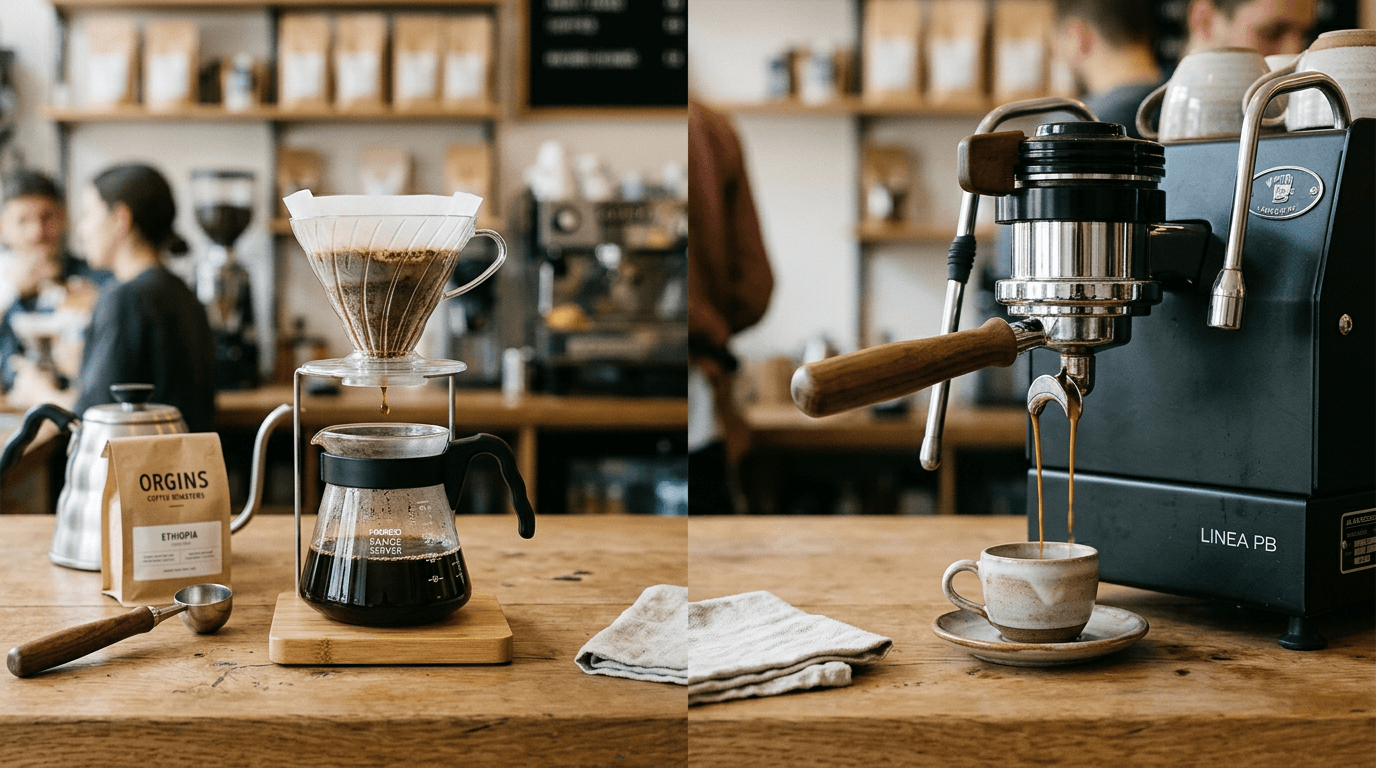
A surprising number of home brewers buy a bag marked "espresso beans" and put them through a standard drip machine, expecting a thick, concentrated shot. When the resulting pot tastes exactly like a standard morning brew, the confusion sets in. The espresso vs coffee debate is fundamentally misunderstood: espresso is not an agricultural plant, a specific roast degree, or a specialized bean. It is a violent, high-pressure extraction mechanism. Taking the exact same specialty coffee bean and passing it through a gravity-fed paper filter yields one beverage, while forcing hot water through a tightly packed puck of that same coffee at nine times atmospheric pressure yields another. Understanding the mechanical division between these two brewing styles dictates not just what hits your cup, but the precise equipment you must invest in to execute either method without wasting your beans.
Quick Summary
The difference between espresso and drip coffee lies entirely in the extraction method. Drip coffee relies on gravity to pull water slowly through coarsely ground beans, creating a high-volume, lower-concentration beverage. Espresso forces hot water through tightly packed, finely ground coffee under immense mechanical pressure, yielding a highly concentrated, syrupy shot in under thirty seconds.
- Extraction mechanism: Gravity percolation versus 9 bars of mechanical pressure.
- Brew ratio: Drip uses approximately 1 part coffee to 16 parts water; espresso uses 1 part coffee to 2 parts water.
- Grind requirements: Drip requires a uniform medium grind; espresso demands extreme micro-adjustments and a very fine, powdery grind.
- Visual markers: Proper espresso extraction creates an emulsified layer of foam called crema, which gravity brewing cannot replicate.
Table of Contents
- Why Pressure Replaces Gravity in the Brew Cycle
- What Makes the Crema Tell the Truth About Your Beans
- Why Concentration Misleads Palates on Strength
- How Water Ratios Dictate the Beverage Category
- Where Dark Roasts Thrive and Fail Under Pressure
- Why Upgrading Your Grinder Matters More Than the Machine
- When to Abandon Drip Mechanics for Pressure Brewing
- Comparison Table
- FAQ
- Recommended Reads
Why Pressure Replaces Gravity in the Brew Cycle
Standard coffee brewers operate on the principle of percolation. Hot water is deposited over a bed of ground specialty-grade coffee, and gravity pulls that water down through the grounds and out of a filter. The flow rate is governed almost entirely by the size of the coffee particles and the depth of the coffee bed. Because gravity is a weak force, the water requires between three and five minutes of contact time to dissolve enough soluble material from the coffee cells to create a balanced cup.
Espresso ignores gravity entirely. A commercial-grade pump forces water through the coffee bed at 9 bars of atmospheric pressure - roughly 130 pounds per square inch. To prevent the water from simply blasting a hole straight through the coffee, the barista must grind the beans incredibly fine and compact them into a dense puck. The water is forced to fight its way through the microscopic gaps between the compressed coffee particles. This violent mechanical friction accelerates the extraction process exponentially. Instead of three minutes, the water strips the soluble flavor compounds from the coffee in just 25 to 30 seconds.
This pressurized environment means that every variable in an espresso shot is highly volatile. A variance of a half-gram of coffee, or a grind size change of a few microns, fundamentally alters the resistance of the puck. If the resistance drops, the pressurized water channels through the weakest point, leaving most of the coffee under-extracted while severely over-extracting the channel itself. Standard drip brewing, with its gentle gravity feed, is highly forgiving of minor inconsistencies in bed depth or grind uniformity.
What Makes the Crema Tell the Truth About Your Beans
The most obvious visual distinction of espresso coffee is the thick, tan layer of foam sitting on top of the liquid. This layer is called crema, and it is a direct result of pressure dynamics. It cannot be created by a standard drip brewer, a French press, or a pour-over.

During the roasting process, carbon dioxide becomes trapped inside the cellular structure of the coffee bean. When you expose a compacted puck of finely ground coffee to 9 bars of pressure, the water acts as a solvent, forcing the trapped CO2 to dissolve into the liquid phase. As the liquid exits the bottom of the portafilter basket and returns to normal atmospheric pressure, that dissolved CO2 immediately expands back into a gas. The expanding gas creates thousands of microbubbles, which become coated in the insoluble coffee oils and melanoidins forced out of the bean by the high pressure. The result is a stable, emulsified foam.
Practical rule: Treat crema as a diagnostic tool rather than a flavor enhancer. If the crema dissipates completely within fifteen seconds of the shot finishing, the extraction channeled heavily, or the beans are too stale to hold sufficient CO2.
Crema provides immediate feedback on the health of your extraction. A pale, thin crema indicates under-extraction or water that was too cold. A dark, unevenly mottled crema with a thick ring around the edge indicates over-extraction or a restrictive, choked shot. When brewing African Espresso, the crema will often look lighter and less dense than a traditional Italian blend due to the lower lipid content and lighter roast profile of high-altitude beans.
Why Concentration Misleads Palates on Strength
When new home brewers ask, is espresso coffee strong, they are usually confusing sensory intensity with chemical reality. In the coffee industry, "strength" is not a measure of roast darkness or caffeine content; it is a strict measurement of Total Dissolved Solids (TDS). TDS represents the percentage of the beverage that is actual coffee material versus pure water.
A properly brewed cup of standard drip coffee yields a very low TDS reading. That means a standard mug consists almost entirely of water with only a tiny fraction of dissolved solids. Espresso, on the other hand, boasts a significantly higher TDS measurement. The resulting liquid is vastly more concentrated than everyday filter coffee. This immense concentration coats the palate in heavy oils and intense acids, leading to the perception of extreme strength.
However, the high concentration does not equal high total caffeine per serving. A standard 2-ounce double shot of espresso contains roughly 60 to 80 milligrams of caffeine. A standard 12-ounce mug of drip coffee contains between 120 and 150 milligrams of caffeine. The longer contact time and higher total volume of water in a gravity brew strip significantly more caffeine from the beans. If your primary goal is chemical stimulation rather than sensory intensity, a slow-steeping method like cold brew coffee or a large batch of drip will always outperform a small, fast espresso extraction.
How Water Ratios Dictate the Beverage Category
Newcomers often ask, is espresso black coffee, assuming the dark, concentrated liquid belongs in a separate category entirely. Technically, any coffee brewed without milk, sugar, or additives is black coffee. However, in practical culinary usage, "black coffee" implies a high-volume, low-concentration beverage. The mechanical line separating espresso and black coffee is strictly defined by the ratio of coffee mass to water volume.
Standard drip brewing relies on a wide ratio to achieve an even extraction over a long period. The golden standard for gravity brewing is roughly a 1:16 ratio - one gram of ground coffee for every sixteen grams of water poured over the bed. This generous amount of solvent ensures the water has enough carrying capacity to dissolve the lighter, floral acids first, followed by the complex sugars, and finally the heavy, bitter compounds, balancing them all in a large volume of liquid.
Espresso operates in extreme deficit. A traditional double shot uses a 1:2 ratio - eighteen grams of dry coffee yielding thirty-six grams of liquid espresso. Because there is so little water acting as a solvent, the 9 bars of pressure are absolutely necessary to force the extraction along. If you attempted a 1:2 ratio in a standard drip brewer, you would yield a sour, unpalatable few drops of under-extracted acid.
Where Dark Roasts Thrive and Fail Under Pressure
Traditionally, dark roast espresso coffee was the standard because prolonged roasting fundamentally alters the physical structure of the bean. The longer a bean spends in the roaster, the more its cellulose structure degrades, making it brittle, porous, and highly soluble. In a brewing environment that only allows water 25 seconds of contact time, high solubility is a massive advantage.
When you pull a dark roast under pressure, the water easily penetrates the broken cell walls, rapidly extracting heavy body, chocolate notes, and deep caramelization. Because the lighter, sharper acids were destroyed in the roaster, the resulting shot is heavy and forgiving. However, this same brittleness becomes a liability if your equipment is flawed. Because the water can dissolve the material so quickly, dark roasts are highly prone to over-extraction. If your grind is slightly too fine, or the water dwells in the puck for 35 seconds instead of 25, the shot will pull overwhelming ash and carbon flavors.
Modern third-wave cafes often push single origin light roasts through espresso machines to highlight bright fruit acidity. Because light roasts are dense and structurally intact, they are stubbornly insoluble. Extracting them under pressure requires pushing the boundaries of the equipment: grinding exceptionally fine, increasing the water temperature, and frequently pulling longer 1:2.5 or 1:3 ratios just to strip enough sweetness from the dense cells to balance the intense acidity.
Why Upgrading Your Grinder Matters More Than the Machine
The most common failure point for home brewers transitioning from drip to espresso is attempting to keep their existing grinder. Standard drip brewing is highly forgiving of grind inconsistency. A basic stepped grinder - one with physical clicks between setting 1 and setting 10 - produces a bimodal distribution of coffee particles that works perfectly fine when water has three minutes to seep through the bed.
Espresso turns the coffee puck itself into the mechanical barrier holding back 130 PSI of water. If your grind distribution is uneven, or if your grinder cannot make microscopic adjustments, you cannot control the pressure. A stepped grinder will routinely fail you here: setting 3 might choke the espresso machine entirely, resulting in no liquid flow, while setting 4 lets the water gush through in ten seconds, creating a thin, sour mess. The precise particle size required for a balanced 25-second extraction almost always lives directly between the physical clicks of a stepped grinder.
To brew espresso successfully, you must use a stepless grinder featuring large, flat or conical burrs that allow for infinite, micro-metric adjustments. You are not just breaking the beans into smaller pieces; you are engineering a structural wall against pressurized water.
Practical rule: Never allocate your budget heavily toward an espresso machine while settling for a cheap grinder. A $3,000 espresso machine paired with a $50 blade grinder will produce undrinkable coffee, while a $300 manual espresso press paired with a high-end stepless flat burr grinder can rival professional cafe quality.
When to Abandon Drip Mechanics for Pressure Brewing
The decision to pivot from gravity brewing to pressure extraction should not be driven by a desire for "better" coffee, but by the specific texture and beverage style you prefer. Drip coffee excels at clarity and volume. If you want to taste the delicate floral notes of a washed Ethiopian bean, or if you need to serve four people efficiently before a morning commute, a high-quality drip brewer is the superior tool. It requires less hands-on attention, the equipment is vastly cheaper, and the daily maintenance takes seconds.
Espresso is a requirement only if you demand heavy, syrupy texture, or if your daily ritual revolves around milk-based drinks like lattes, cortados, or flat whites. The intense concentration of an espresso shot allows it to punch through eight ounces of steamed milk without losing its structural identity - a task that a standard gravity-brewed coffee will fail entirely, resulting in a watery, beige cup.
If you are uncertain about committing to the extreme equipment costs and steep learning curve of an espresso setup, exploring various roast profiles through sample packs on a good drip brewer often reveals more flavor complexity than a poorly executed espresso shot.
Comparison Table
| Specification | Standard Drip Coffee | Espresso Extraction |
|---|---|---|
| Mechanism | Gravity Percolation | 9 Bars Mechanical Pressure |
| Typical Brew Time | 3.5 to 5 Minutes | 25 to 30 Seconds |
| Standard Brew Ratio | 1:15 to 1:18 (Coffee to Water) | 1:1.5 to 1:2.5 (Coffee to Water) |
| Grind Requirement | Medium (Stepped grinder acceptable) | Extremely Fine (Stepless grinder required) |
| TDS (Concentration) | 1.1% to 1.5% | 8.0% to 12.0% |
| Visual Signature | Clean, translucent liquid | Opaque liquid with heavy crema |
FAQ
What is the primary difference between coffee and espresso? The difference is entirely mechanical. Standard coffee is brewed by allowing gravity to pull water through coarsely ground beans over several minutes. Espresso is brewed by a machine forcing water through tightly packed, finely ground beans at high pressure in under thirty seconds.
Can I use any coffee bean in an espresso machine? Yes. While roasters label certain bags as "espresso blends," this usually just means the beans were roasted darker and blended for higher solubility and thicker crema. You can extract any coffee bean under pressure, though lighter roasts will require more precise grinding and temperature control to avoid sourness.
Why does my home espresso taste unpleasantly sour compared to my drip brew? Sourness is the primary indicator of under-extraction. Because espresso relies on a fast 25-second contact time, if your water is too cold, your grind is too coarse, or your coffee-to-water ratio is too tight, the water will only strip the fast-dissolving acids from the beans and leave the balancing sugars behind.
Do I need a separate grinder if I drink both drip and espresso? While some high-end grinders can swing between coarse drip settings and fine espresso settings, switching back and forth usually wastes coffee as you purge the chamber and recalibrate the burrs. Most practitioners maintain a stepless grinder solely dialed in for their espresso machine, and a simpler stepped grinder for their drip brewer.