Coffee Shop Equipment Sourcing: 4 Distributor Profiles for 2026
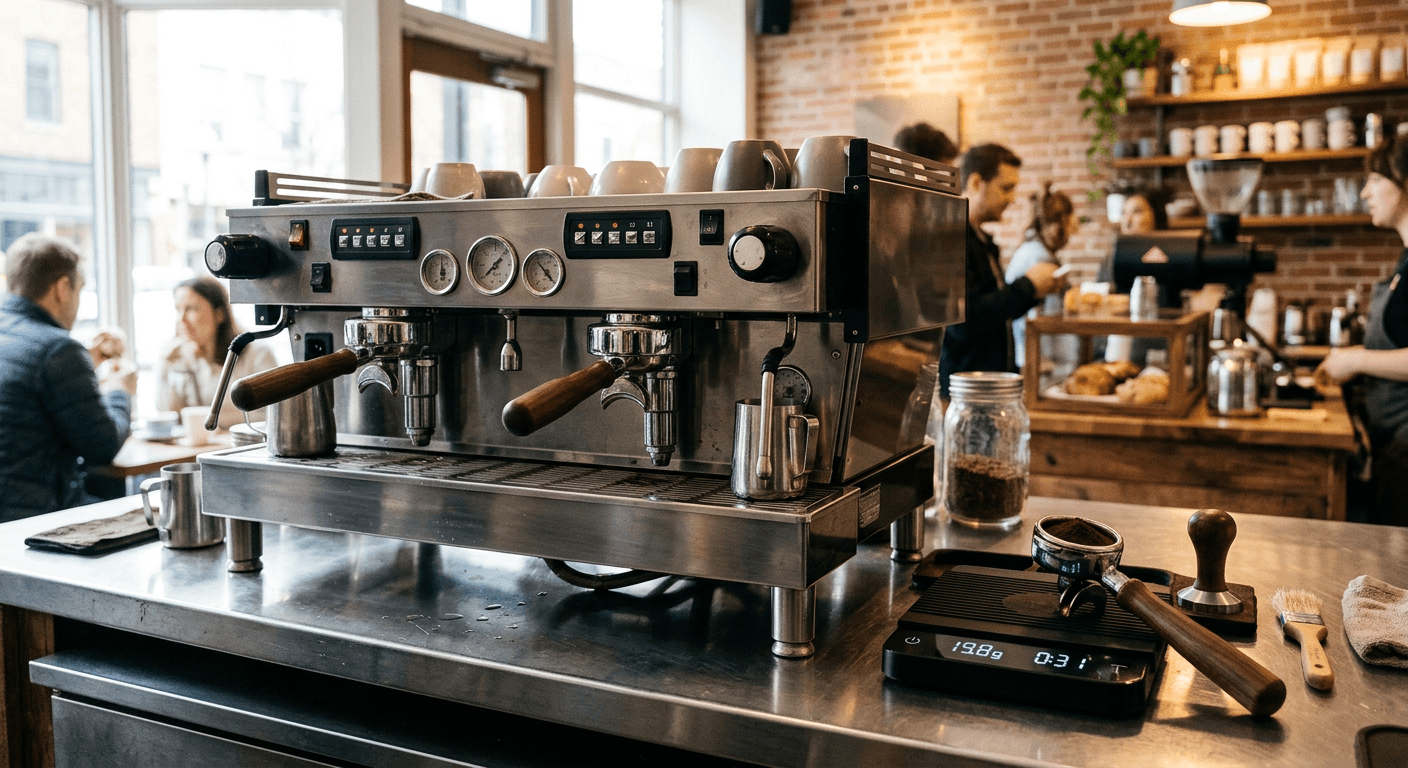
Most cafe owners assume their primary constraint is square footage, but the true bottleneck is thermal stability during a morning rush. Sourcing the right coffee shop equipment dictates whether a barista can pull 60 shots an hour or falls behind on ticket three. Relying on a consumer-focused retailer for high-volume service machinery inevitably leads to burnt-out rotary pumps and voided warranties, while buying prosumer gear from an enterprise outfitter means paying exorbitant freight fees for lightweight deliveries. The decision comes down to matching the supplier's logistics to the cafe's actual throughput.
Quick Summary
Choosing a distributor for cafe machinery requires aligning a supplier's freight logistics, return penalties, and warranty structures with the specific volume of the target coffee station.
- Enterprise outfitters mandate severe restocking fees but offer necessary financing.
- Consumer-focused retailers provide cheap shipping but exclude commercial machinery.
- Specialty generalists excel at accessory fulfillment but struggle with heavy freight logistics.
- Freight return penalties easily consume any potential refund, making careful specification critical.
Table of Contents
- Matching Brewing Methods to Equipment Specifications
- 1. Coffee Machine Depot USA
- 2. Whole Latte Love
- 3. Prima Coffee Equipment
- 4. Voltage Coffee Supply
- Aligning Sourcing to Operational Reality
- Recommended Reads
| Product | Sourcing Scale | Features | Pros | Cons | Target Audience |
|---|---|---|---|---|---|
| Coffee Machine Depot USA | Commercial-First Outfitter | Click Lease financing, refurbished options | 24-60 month financing, Multiple premium brands, Dedicated commercial support | 20% restocking fee, Strict 30-day return window, Used items only carry 3-month parts warranty | High-volume cafes needing multi-group espresso machines |
| Whole Latte Love | Prosumer Hybrid Retailer | Tiered warranty repair, home focus | Waives restocking fee on exchanges, Clear warranty repair rates, Free shipping over $75 | Commercial products excluded from free shipping, 5% restocking fee on US returns, Consumables non-returnable | Offices and low-volume coffee stations |
| Prima Coffee Equipment | Specialty Coffee Generalist | Fast dispatch, accessory aggregation | In-stock items ship within 24 hours, Free shipping over $100, Broad specialty tool selection | Strict commercial manufacturer return fees, 20% restocking for dirty returns, Drop-ship items often non-returnable | Specialty shops needing diverse manual brewing tools |
| Voltage Coffee Supply | Commercial-First Outfitter | Supplemental warranty, flat freight logic | 30-day supplemental warranty, 5% newsletter discount, Free economy shipping over $129 | $350 flat freight fee on returns, 10% restocking fee for freight, $12 prepaid label deduction | Established cafes with finalized architectural schematics |
Matching Brewing Methods to Equipment Specifications
The machinery required to extract a dense, highly concentrated shot of espresso differs structurally from the hardware needed to produce high-clarity filter coffee. Attempting to source both from a single distributor without evaluating their specific competencies usually results in compromised performance on one side of the menu.
Espresso extraction demands relentless thermal stability. A commercial machine pulls cold water through a rotary pump, pushes it into a heat exchanger or dedicated brew boiler, and forces it through a compacted puck of coffee at nine bars of pressure. In a high-volume environment pouring a dark African Espresso, multi-boiler machines equipped with PID (Proportional-Integral-Derivative) controllers are mandatory to prevent the brew water from dropping in temperature after consecutive shots. This heavy coffee equipment requires dedicated 220V power and direct plumbing, which severely limits where it can be installed.
Conversely, batch brewing relies on thermal mass and controlled bypass valves to achieve proper extraction over a longer contact time. Commercial batch brewers dispense large volumes of water over a flat-bottomed bed of grounds, filtering into thermal carafes that maintain temperature without applying direct heat. This process highlights the specific flavor notes in lighter Blends without the astringency caused by hot plates.
Manual brewing, or pour-over, strips away automation entirely and shifts the burden of precision onto specialized coffee tools. A barista needs a variable temperature gooseneck kettle for flow restriction and a highly responsive coffee scale capable of measuring down to a tenth of a gram. Sourcing these lighter coffee accessories requires a distributor that turns inventory quickly and carries niche brands, rather than an outfitter focused entirely on heavy freight.
Defining the Sourcing Scale
To navigate the distributor landscape, we evaluate suppliers along a specific classification axis: Sourcing Scale. This lens categorizes vendors based on the logistical realities of their inventory and fulfillment models.
- Commercial-First Outfitter: These distributors specialize in heavy freight, direct plumbing schematics, and high-voltage machinery. They operate on thin margins for large orders, meaning their return policies are punitive. They should never be compared to agile, consumer-facing retailers.
- Prosumer Hybrid Retailer: Sitting between domestic use and light commercial application, these vendors stock equipment capable of serving small offices or low-volume carts, but lack the infrastructure to support a 500-cup-a-day cafe.
- Specialty Coffee Generalist: These suppliers aggregate smallwares, manual brewing gear, and replacement parts. They excel at rapid parcel delivery but frequently outsource heavy machinery fulfillment to manufacturer drop-shipping.
Practical rule: Never buy heavy machinery from a vendor that relies entirely on drop-shipping; you will inherit the manufacturer's lead times and return penalties without any intermediary support.
1. Coffee Machine Depot USA
Is the upfront capital for a multi-group espresso machine restricting your buildout? Coffee Machine Depot USA operates as a custom, new, and refurbished commercial machinery hub tailored for enterprise deployment. Operating strictly as a Commercial-First Outfitter, this supplier structures its inventory around established cafe infrastructure rather than domestic experimentation.
It functions by bridging the gap between heavy equipment acquisition and cash flow management. The distributor sells major commercial equipment brands including La Marzocco, Victoria Arduino, Rocket Espresso, Sanremo, Nuova Simonelli, Wega, Rancilio, and Astoria. Instead of requiring full upfront payment for these high-ticket items, it offers flexible financing options through Click Lease with terms ranging from 24 to 60 months. Capital costs dictate everything. By spreading the financial burden across several years, operators can secure multi-boiler stability without depleting their operating reserves before opening day. Furthermore, new products carry a 12-month parts-only warranty from shipment, while used products carry a 3-month parts-only warranty.
Capital flexibility offsets restrictive return windows
We would hesitate to recommend this route for low-volume carts where the restocking penalty outweighs the financing benefit. The steep boundary here is the return policy. Approved returns are subject to a 20% restocking fee and must be initiated within 30 days of the purchase date, leaving zero room for indecision. If a cafe orders a three-group machine and realizes during installation that they only have space for a two-group footprint, that error costs thousands of dollars in penalties.
Opt for this supplier when building a high-volume cafe that requires staggered financing for expensive multi-group machines.
Pros
- Carries industry-standard commercial brands
- Provides 24 to 60 month lease terms
- Offers refurbished machinery with baseline warranties
Cons
- Enforces a strict 30-day return cutoff
- Mandates a heavy 20% restocking penalty on approved returns
- Limits used equipment to a short 3-month parts warranty
2. Whole Latte Love
Unlike suppliers dedicated purely to high-volume commercial buildouts, this retailer bridges the gap between high-end home use and light cafe service. Because it sits firmly in the Prosumer Hybrid Retailer category, the inventory skews toward single-group machines, independent grinders, and automated solutions designed for countertops rather than reinforced commercial bars.
Fulfilling orders here involves incentivizing smaller retail transactions while compartmentalizing warranty support. It accepts returns up to 30 days from delivery, but excludes coffee, parts, accessories, cleaning products, and filtration items from this policy. Home setups operate differently. When a machine requires maintenance, the company charges flat return shipping for warranty repairs in the contiguous US: $29 for grinders/semi-automatics, $39 for super-automatics, and $49 for prosumers. This tiered flat-rate system removes the ambiguity of shipping heavy metal back to a service center, allowing office managers to calculate the exact cost of maintenance downtime.
Residential focus complicates commercial deployment
I would hold off if outfitting a primary cafe line due to the shipping exclusions on commercial gear. Checking out reveals the boundaries of its shipping policies. It provides free standard shipping on qualifying retail orders within the contiguous United States, but entirely excludes commercial products from this benefit. Furthermore, it applies a percentage-based restocking fee on returned items in the US, which is only waived if exchanging for an item of equal or greater value.
Consider this route for residential upgrades or office setups where consumer-grade warranties suffice.
Pros
- Waives restocking penalties on direct exchanges
- Establishes predictable flat-rate warranty shipping
- Offers free shipping on lightweight retail orders
Cons
- Excludes commercial items from free shipping
- Refuses returns on filtration and cleaning parts
- Penalizes standard returns with a 5% fee
3. Prima Coffee Equipment
Moving from a single espresso group to a diversified menu of pour-overs and batch brews usually forces a frantic search for specialized manual tools. As a Specialty Coffee Generalist, this retailer aggregates niche brewing hardware, replacement burrs, and water filtration systems into a single logistics pipeline.
It works by prioritizing rapid dispatch for smallwares while acting as a broker for heavier equipment. The supplier ships in-stock items within 24 hours of order completion (excluding weekends) and partner-stocked items within 1-2 business days. Speed changes the calculation. By offering free standard ground shipping to the contiguous 48 US states on orders over $100 or products displaying a free shipping badge, it allows a cafe manager to rapidly replace a broken portafilter basket or stock up on filter papers without waiting on a slow-moving freight manifest.
Fulfillment speed hits a wall at commercial freight
What would make us hesitate is outfitting an entire cafe with heavy machinery from a vendor that penalizes drop-shipped returns so severely. The limitation lies in heavy freight handling. It restricts returns on commercial equipment and drop-shipped items, which are either non-returnable or subject to strict manufacturer restocking fees. Even on standard items, it charges a restocking fee of up to 20% for returned items requiring cleaning, parts, new packaging, or that fail basic return guidelines.
Turn to this vendor to rapidly source specialized hand tools and accessories before a soft opening.
Pros
- Dispatches local inventory within 24 hours
- Clears the free shipping threshold at just $100
- Consolidates niche specialty brewing gear
Cons
- Applies up to 20% penalty for dirty returns
- Abdicates commercial return policies to manufacturers
- Labels drop-shipped machinery as largely non-returnable
4. Voltage Coffee Supply
According to its published policies, this supplier covers all orders with a supplemental 30-day warranty after delivery, acting as a buffer before the original manufacturer's warranty takes over. Positioned as a Commercial-First Outfitter, this distributor bypasses prosumer compromises to directly supply established shops with high-capacity brewers, multi-group espresso machines, and critical replacement parts.
Moving 200-pound pallets across the country forces tight margin controls. It provides free economy shipping to the contiguous US on the majority of qualifying orders. Freight logistics dominate here. To offset customer acquisition costs in a low-margin sector, it offers a promotional discount on orders when customers sign up for the official company newsletter. This structural focus on reducing upfront costs benefits operators who know exactly which water filtration specifications and boiler sizes their plumbing can support.
Practical rule: Never uncrate heavy machinery until the electrical drop has been physically tested; returning an unboxed commercial machine triggers repackaging fees that dwarf standard restocking rates.
Freight logistics dictate the true cost of changes
I would hold off on ordering until the final architectural plans are stamped, given the severe freight return costs. Reversing an order mistake triggers heavy financial penalties. It deducts a $12 shipping charge for prepaid label returns, and subjects freight returns to a 10% restocking fee plus a punishing $350 flat freight fee. If you order the wrong grinder and it ships via LTL freight, correcting that error incurs both the flat freight penalty and the percentage deduction.
Secure machinery through this distributor when cafe schematics are finalized and the risk of returning heavy pallets is eliminated.
Pros
- Provides an immediate 30-day supplemental warranty
- Offers a 5% discount via newsletter registration
- Ships most orders over $129 for free
Cons
- Levies a $350 flat fee on freight returns
- Stacks a 10% restocking penalty on top of freight costs
- Deducts label costs for standard returns
Aligning Sourcing to Operational Reality
Selecting the right vendor is rarely about finding the absolute lowest price; it is about matching the supplier's logistical constraints to your operational timeline.
If your buildout requires high-voltage equipment, direct plumbing, and multi-group stability, a Commercial-First Outfitter is mandatory. These suppliers absorb the complexities of freight shipping and offer critical financing options, but they demand absolute certainty. A mistake on a freight order will cost hundreds of dollars in restocking and flat-rate return fees.
If you are setting up an office coffee station or a low-volume residential bar, a Prosumer Hybrid Retailer provides the right balance. They offer clear, flat-rate warranty repair shipping and waive penalties on exchanges, though they will actively exclude heavy commercial gear from their shipping incentives.
If your primary need is sourcing coffee bar accessories, scales, and independent manual brewing tools, lean on a Specialty Coffee Generalist. They move lightweight inventory rapidly, often dispatching within 24 hours, but they are not the appropriate channel for sourcing 200-pound espresso machines due to their reliance on restrictive manufacturer drop-shipping policies.