Beyond the Label: How Fair Trade Coffee Certification Alters Sourcing and Quality
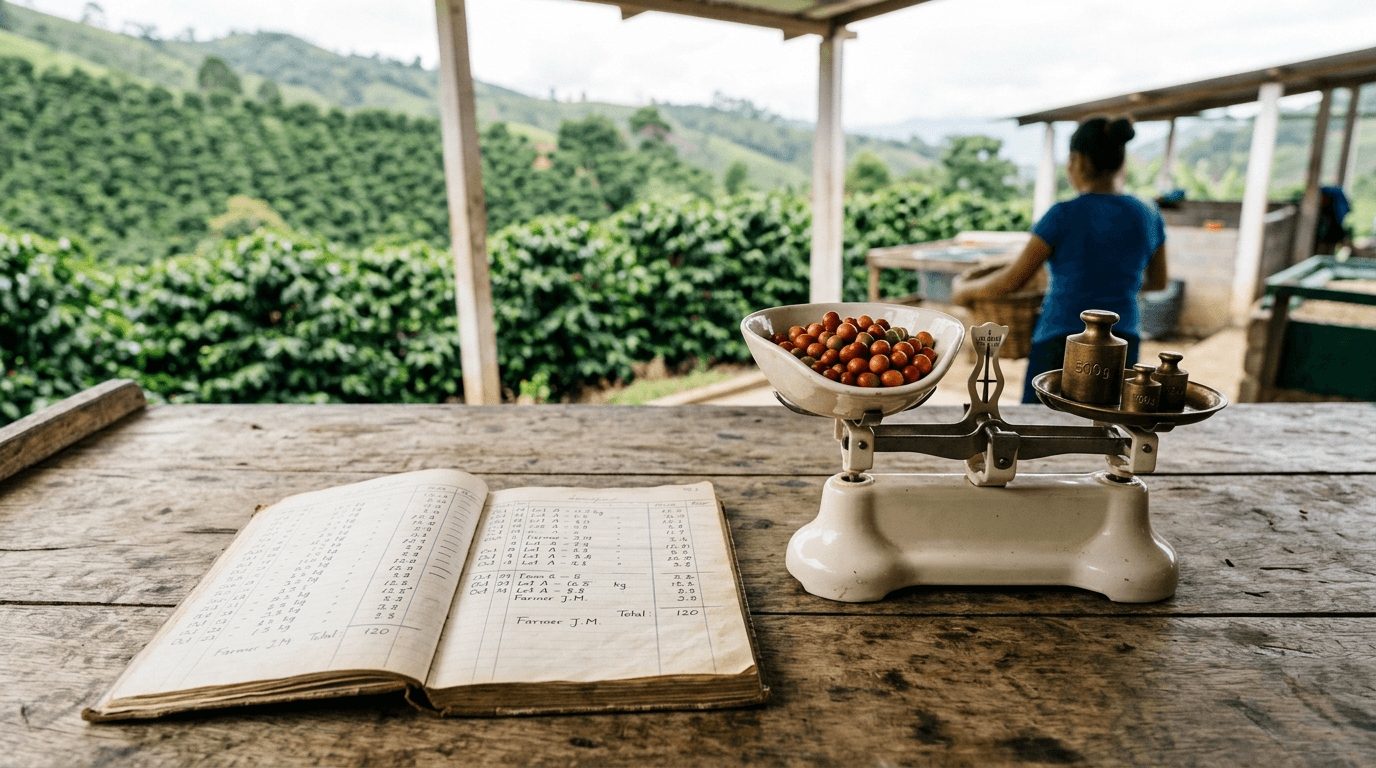
The most pervasive misconception regarding the fair trade coffee definition is the assumption that the certification inherently guarantees a better-tasting cup. This gets the mechanism completely backward. Fair trade is fundamentally a financial and organizational framework, designed to decouple a farmer’s income from the severe volatility of the global commodities market. It establishes a price floor and a social premium, securing a baseline livelihood regardless of how commercial crop futures perform. However, an economic safety net does not dictate agricultural precision. Translating that financial stability into an 85-point specialty cup score requires distinct, secondary efforts in agronomy, processing, and direct buyer relationships.
Quick Summary
Fair trade certification is an economic intervention in the coffee supply chain that guarantees cooperatives a minimum price and an additional community premium. While it shields smallholder farmers from market crashes, it operates independently of specialty quality metrics.
- Price floors: Protects farmers from the volatility of the New York C-Market.
- Cooperative structure: Certification is typically held by democratically run cooperatives, not individual farms.
- Quality disconnect: A fair trade label guarantees a financial baseline, not a specific cup score.
- Audit friction: The administrative burden of maintaining certification can lock out the smallest producers.
Table of Contents
- Why a price floor changes agricultural planning
- Where the economic safety net limits cup quality
- The friction points that strip cooperatives of certification
- How buyers track certified fair trade coffee
- Deciding when organic and fair trade coffee overlap
- Why modern coffee fair trade companies bypass the label
- FAQ
- Recommended Reads
Why a price floor changes agricultural planning
Coffee is traded globally as a commodity on the Intercontinental Exchange (ICE), commonly referred to as the C-Market. Because it is a traded future, the price of conventional coffee fluctuates wildly based on macroeconomic factors completely disconnected from a smallholder farmer's daily reality. A frost in Brazil or a currency swing in Europe can crash the per-pound price globally, driving it below the actual cost of production for farmers in other regions.
The core mechanism of fair trade coffee is the intervention against this volatility. By setting a mandatory minimum price, the certification ensures that when the C-Market crashes, registered cooperatives still receive a baseline payment that covers sustainable production costs. If the C-Market price rises above this minimum floor, fair trade rules dictate that buyers must pay the higher market price.
Alongside this floor, buyers pay an additional Fairtrade Premium. This is a distinct, non-negotiable sum paid per pound directly into a communal fund managed by the cooperative. Farmers use this stability to plan. When future contract values are guaranteed, cooperatives can secure pre-harvest financing to purchase fertilizers, maintain wet mills, or repair transport vehicles. Without this floor, smallholders cannot secure the credit necessary to prepare for the upcoming harvest. For buyers analyzing single-origin coffees, a cooperative backed by this financial stability is significantly more likely to deliver consistent volumes year over year.
Where the economic safety net limits cup quality
Financial stability and agricultural excellence are related, but they are not the same mechanism. A price floor protects against bad markets, but it can perversely disincentivize meticulous quality control if not managed correctly.
If a cooperative knows it will receive the guaranteed fair trade minimum regardless of whether a lot scores an 80 (standard commercial grade) or an 86 (specialty grade), the immediate incentive shifts toward maximizing yield rather than isolating quality. Meticulous selective picking - harvesting only perfectly ripe cherries while leaving under-ripe ones on the branch - costs more in labor. If the buyer is paying the bare minimum certification price, the farmer loses money by spending extra labor on selective picking.
Practical rule: If your primary goal is both ethical sourcing and high cup scores, look for roasters who use the certification as a starting point, not the final price, paying distinct quality premiums on top of the fair trade minimum.
This is where the separation between standard fair trade coffee beans and specialty-grade fair trade lots occurs. Roasters seeking complex acidity and distinct flavor clarity must negotiate quality premiums that sit well above the certification's baseline. Without this secondary financial incentive, farmers logically blend their highest-quality yields with their average yields to achieve the required volume for the contract, flattening the overall profile. Crafting highly specific coffee blends requires purchasing from cooperatives that have established separate processing streams for their premium lots.
The friction points that strip cooperatives of certification
Obtaining and keeping a coffee fair trade certification is an administrative heavy lift. It is not granted in perpetuity; it requires annual audits by independent bodies like FLOCERT. When cooperatives lose their status, it is rarely due to a malicious violation of labor standards. Instead, they typically fall victim to three distinct operational failures.
First is audit fatigue and administrative overhead. The cooperative must pay for the audits. If global coffee prices rise and buyers are paying high rates on the conventional market, the financial benefit of the fair trade minimum evaporates. Cooperatives may decide the cost of maintaining the paperwork outstrips the value of the label, allowing their certification to lapse.
Second is traceability failure at the collection station. Cooperatives aggregate beans from hundreds of smallholder farmers. If a farmer attempts to sell a non-certified neighbor's yield under their own quota to secure the premium, and the cooperative fails to catch this blending, the entire organization risks suspension during an audit.
Third is premium mismanagement. The social premium must be allocated via democratic vote. If the elected committee funds a community project - like a medical clinic - that fails mid-construction, or if funds are consumed entirely by the cooperative's own administrative salaries rather than reaching the farmers, the certifying body will revoke the status. Exploring diverse profiles via coffee sample packs often reveals the stark difference in consistency between cooperatives with strong internal governance and those struggling with administrative bloat.
How buyers track certified fair trade coffee
Tracking an agricultural product from a rural mountainside to a commercial roastery involves significant logistical friction. The certification relies on two primary tracking mechanisms to verify that the product sold matches the premium paid: Identity Preserved (physical traceability) and Mass Balance.

Identity Preserved means the exact beans harvested by the certified cooperative are kept physically separated throughout milling, exporting, and roasting. When a consumer buys this bag, the physical beans inside are the exact ones grown by the certified farmers. This is the standard for high-end specialty coffee, where terroir and specific processing methods define the product.
Mass Balance operates on an equivalency model. A large commercial roaster might purchase 10,000 pounds of certified coffee and 50,000 pounds of conventional coffee. At the dry mill or the export facility, these beans might be physically mixed to achieve a uniform commercial flavor profile. However, the roaster is only permitted to apply the fair trade label to 10,000 pounds of their final retail product. The financial transaction occurred correctly, and the farmers received their premium, but the physical bean in a specific bag may not be the certified one. When purchasing entire coffee collections, understanding whether a brand utilizes physical traceability or mass balance dictates the level of transparency you can expect regarding the exact origin of the beans.
Deciding when organic and fair trade coffee overlap
Many consumers view organic and fair trade labels as interchangeable ethical markers, but they represent entirely different operational realities for the farmer. Dual-certified organic and fair trade coffee represents the strictest, most labor-intensive category in agricultural exporting.
Transitioning to organic farming requires a three-year period where synthetic fertilizers and pesticides are stripped from the land. During this transition, crop yields predictably plummet because the soil is cut off from synthetic nitrogen, yet the farmer cannot legally sell the crop at the organic premium price until the three-year mark is cleared. The fair trade minimum price is often the only mechanism that allows a cooperative to survive this transition period without defaulting on their land.
However, dual certification introduces immense agronomic risk. Without synthetic fungicides, an outbreak of coffee leaf rust (la roya) can decimate an entire organic harvest in weeks. If the crop fails, the fair trade price floor means nothing, because the farmer has no volume to sell.
Practical rule: Support dual-certified coffees when purchasing Central or South American beans where cooperative structures are highly organized to manage organic transition risks, but recognize that in regions with fragmented infrastructure, demanding both labels simultaneously can inadvertently exclude highly sustainable farmers who cannot afford the dual audit fees.
Why modern coffee fair trade companies bypass the label
A growing segment of specialty roasters completely abandons third-party certification in favor of direct trade models. This is not an evasion of ethical sourcing; it is a structural critique of how certification costs are distributed.
In a direct trade model, the roaster bypasses the commodities market entirely. They travel to the farm or estate, cup the harvest, and agree on a flat price per pound that often sits two to three times higher than the C-Market rate and significantly above the fair trade minimum. Because no third-party auditing body is involved, neither the roaster nor the farmer pays licensing fees. Every dollar negotiated goes directly into the supply chain.
This approach suits medium-to-large single estates that have the infrastructure to mill and export their own coffee. It does not suit a remote smallholder farmer who produces only five bags of coffee per year. That smallholder relies entirely on the aggregation power of a cooperative, which in turn relies on the standardization of the fair trade system to access international buyers. Assessing complex offerings, such as the 6 Bean Blend profile, often requires roasters to utilize a mix of direct trade relationships for estate coffees and fair trade cooperative contracts for foundational smallholder volumes.
Comparison Table: Coffee Sourcing Models
| Sourcing Model | Price Basis | Quality Incentive | Verification Method | Best Suited For |
|---|---|---|---|---|
| Fair Trade Certified | Fixed minimum floor + social premium | Low (unless negotiated separately) | 3rd-party audits (FLOCERT) | Smallholder cooperatives needing baseline stability. |
| Direct Trade | Flat negotiated rate based on cup score | Extremely High | Roaster transparency & direct relationship | Medium/large estates producing 85+ specialty grades. |
| Conventional Market | ICE C-Market volatile trading price | None (volume focused) | Standard commercial export documents | Mass-market commercial blending and instant coffee. |
Maintaining freshness and strict quality control, especially when packaging into formats like 12-pack single-serve coffee capsules, requires raw material that has been carefully stabilized at the farm level - a stability directly funded by the economic models chosen by the buyer.
FAQ
What is the strict fair trade coffee definition?
It is a certification framework that guarantees a minimum purchase price and an additional communal premium for coffee grown by registered, democratically organized cooperatives, insulating farmers from global commodity market crashes.
Does a fair trade label mean the coffee is organic?
No. Fair trade focuses on economic and labor standards, while organic certification focuses on agronomy and the absence of synthetic chemicals. A coffee can be fair trade without being organic, though dual-certified options exist.
Why do some highly rated specialty roasters not carry the certification?
Many specialty roasters use a direct trade model, negotiating prices far above the fair trade minimum directly with farmers. They skip the label to avoid the heavy administrative auditing fees imposed on the farmers and themselves.
How is the fair trade premium actually spent?
The premium is paid into a communal cooperative account, not directly to individual farmers. The cooperative's elected committee votes on how to utilize it, which can range from building local medical clinics to upgrading shared wet mills or subsidizing fertilizer purchases.