7 Coffee Filters Explained: How Material Changes Your Brew
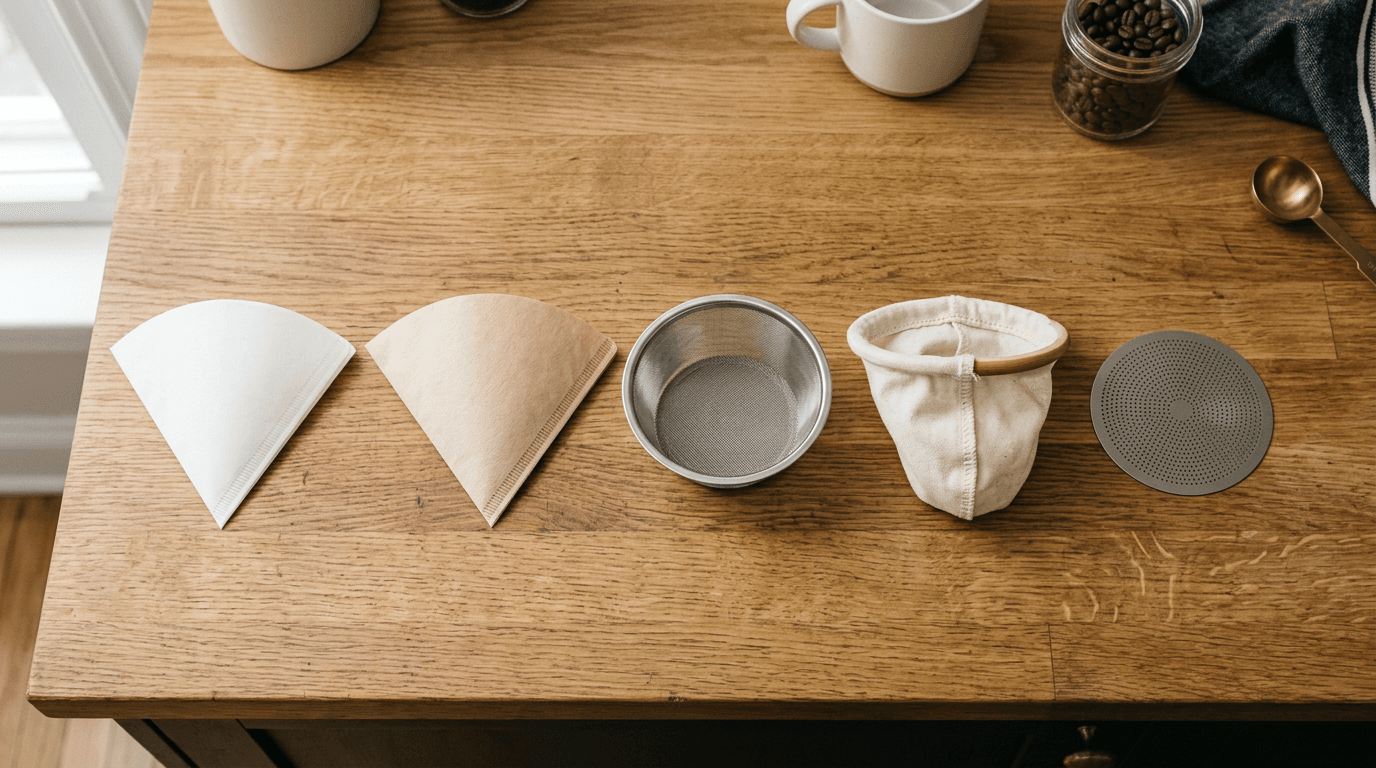
You dial in a light-roasted washed Ethiopian bean, pour your water at exactly 205 degrees Fahrenheit, and still pull a muddy, flat cup that tastes more like wet cardboard than jasmine. The variable blinding you to those floral notes is not your grinder or your technique. It is the medium separating the grounds from the carafe. Understanding how coffee filters dictate cup clarity and oil retention is the defining step between a heavy, full-bodied morning mug and a delicate, tea-like extraction.
Quick Summary
Coffee filters act as the extraction gatekeeper, determining whether microscopic coffee fines and insoluble lipids make it into your final cup. While standard paper yields high clarity by trapping oils, metal and cloth alternatives prioritize body and texture over visual cleanliness.
- Bleached paper delivers the highest flavor clarity and zero papery aftertaste without extensive rinsing.
- Metal meshes allow diterpenes (coffee oils) and micro-fines to pass, mimicking immersion brewing in a pour-over format.
- Cloth flannel offers a middle ground of high oil retention with zero sediment, but requires rigorous daily sanitation.
- Filter shape fundamentally alters water flow: cones channel water to a single point, while flat bottoms create an even extraction bed.
Table of Contents
- How Coffee Filters Dictate Cup Profile
- 1. Bleached Paper Cones
- 2. Unbleached Natural Paper
- 3. Woven Wire Mesh
- 4. Cotton Cloth Flannels
- 5. Flat-Bottom Wave Papers
- 6. Photo-Etched Metal Disks
- 7. Thick Laboratory-Grade Paper
- Which Material Fits Your Bottleneck
- FAQ
- Recommended Reads
How Coffee Filters Dictate Cup Profile
A filter does far more than keep sediment out of your teeth. It operates on two distinct mechanical fronts: porosity and lipid retention. Porosity dictates the physical flow rate of the water through the coffee bed. A highly porous material drains quickly, requiring a finer grind size to create resistance, while a dense material acts as its own flow restrictor. Lipid retention is chemical. Coffee beans contain cafestol and kahweol, oily diterpenes that give espresso its heavy mouthfeel. Paper fibers absorb these oils almost completely. A brew pushed through thick paper will pour translucent and taste highly articulated, making it ideal for picking out individual flavor notes in Single Origin coffees, but it will physically feel thinner on the palate.
Comparison Table
| Filter Type | Primary Trait | Oil Retention | Clarity Level | Ideal Coffee Style |
|---|---|---|---|---|
| Bleached Paper | Neutral taste | Low | Very High | Light roasts, florals |
| Unbleached Paper | Requires deep rinse | Low | High | Medium roasts |
| Metal Mesh | Allows sediment | High | Low | Dark, punchy blends |
| Cloth Flannel | Traps silt, passes oil | Medium-High | Medium | Complex, heavy roasts |
| Flat-Bottom Paper | Even extraction | Low | High | Standard house coffees |
| Etched Metal Disk | High flow rate | High | Medium | Travel/immersion setups |
| Thick Lab Paper | Heavily restricted flow | Zero | Absolute | Bright, acidic beans |
1. Bleached Paper Cones
Bleached paper cones, commonly recognized in V60 formats or the wedge shape popularized by standard Melitta coffee filters, undergo an oxygen or chlorine-dioxide bath to remove residual lignin from the wood pulp. They are designed for manual percolation brewers where gravity pulls water through a tapered bed of grounds.
The oxygen-cleansing process leaves behind an inert cellulose structure. As water passes through, this dense microscopic mesh physically traps almost all suspended solids and wicks away coffee oils. Because the natural woody compounds have already been oxidized out at the factory, the paper contributes virtually zero flavor to the hot water passing through it.
Absolute clarity at the expense of texture
This material provides the highest possible flavor articulation. The total removal of lipids means the resulting liquid is structurally light, allowing acidic fruit notes and delicate floral aromatics to dominate the palate rather than being masked by heavy fats.
This exact mechanism is its limit. Stripping out the oils fundamentally thins the mouthfeel. If you are brewing a low-acidity, dark roasted Indonesian bean hoping for a rich, syrupy texture, bleached paper will hollow out the body and leave the cup tasting unexpectedly weak. It explicitly punishes coffees that rely on heavy mouthfeel to balance their roast profiles.
2. Unbleached Natural Paper
Unbleached filters skip the final oxidation step in paper manufacturing, retaining the natural brown hue of the raw wood pulp. They are marketed to environmentally conscious home brewers who prefer minimally processed goods.
Mechanically, they perform the same physical filtration as their bleached counterparts, trapping fines and absorbing oils. However, the retained lignin and wood sugars in the fibers remain highly soluble in hot water. Some batches of unbleached stock are stiff enough to be repurposed for crafts like coffee filter flowers, but in a brewer, this thick, dense structure acts as a flavor reservoir. When boiling water hits dry, unbleached paper, it rapidly dissolves these organic compounds directly into your carafe.
Earthy taint ruins delicate roasts without aggressive rinsing
If you pour hot water over dry unbleached paper and smell the resulting runoff, it smells distinctively like a wet cardboard box. Skipping the rinse step guarantees this papery astringency will overwrite the nuances of your coffee.
Practical rule: If the rinse water smells like wet cardboard, the filter is not ready for coffee.
To bypass this limitation, you must aggressively rinse unbleached filters with roughly 100 to 150 grams of boiling water before adding grounds. This requirement makes them remarkably inefficient for brewers trying to conserve hot water or expedite their morning routine. For highly delicate, tea-like roasts, the residual risk of a woody aftertaste makes unbleached paper a distinct liability.
3. Woven Wire Mesh
Constructed from stainless steel wire woven into a micro-mesh (typically 300 to 400 microns), a reusable coffee filter physically drops into standard cone or wedge drippers. It is built for longevity and waste reduction, designed to outlast thousands of brewing cycles.

Instead of absorbing liquids through fibrous capillary action, steel mesh strictly filters by particle size. The microscopic gaps allow water, emulsified oils, and tiny coffee particles (fines) to pass freely into the carafe. This mechanism entirely changes the extraction dynamics of a pour-over, essentially recreating the unfiltered emulsion of a French Press while utilizing a continuous fresh-water flow.
Full immersion body packed into a percolation shape
The resulting cup is heavy, opaque, and coats the tongue. It perfectly compliments punchy, dark-roasted profiles like a 6 Bean Blend by preserving the heavy lipids that give the roast its character.
The inescapable downside is cup clarity. The fines that pass through the mesh will settle as a layer of sludge at the bottom of your mug. Furthermore, stainless steel mesh is notorious for accumulating polymerized coffee oils in the wire junctions. Over time, these trapped oils go rancid and choke the flow rate, stalling your brew. A mesh cone requires routine deep cleaning with an alkaline espresso machine detergent to perform consistently.
4. Cotton Cloth Flannels
Historically popularized by Japanese Nel Drip setups, cloth filters consist of thick cotton or flannel woven into a sock or cone. They appeal to traditionalists seeking an extraction profile that sits exactly between the cleanliness of paper and the heavy body of metal.
Cotton threads are inherently dynamic. When hit with hot water, the natural fibers swell, drastically shrinking the gaps between the weave. This swollen matrix is tight enough to trap microscopic fines - preventing the muddy sediment associated with steel mesh - but unlike paper cellulose, the cloth is porous enough to let heavy coffee oils slip through. Because of this unique filtration style, thick cloth is often used as the core filtration step for Cold Brew Coffee setups that require long steeping times without adding papery flavors.
Unmatched lipid retention paired with high maintenance
Cloth filters yield a cup that is visually clean but texturally rich, preserving a syrupy mouthfeel without leaving grit in your teeth. They bring out the sweetness in medium roasts beautifully.
The honest limit of cloth is the grueling sanitation protocol. Cotton acts as a sponge for rancid coffee fats. You cannot simply wash a flannel filter with dish soap, as the fibers will absorb the soap and ruin subsequent brews. Between uses, cloth filters must be vigorously rinsed with boiling water and stored submerged in fresh water in the refrigerator, or frozen in a sealed bag. If allowed to dry out on the counter, the trapped oils rapidly oxidize, permanently ruining the fabric with a stale, sour taint.
5. Flat-Bottom Wave Papers
Designed with ruffled sides and a completely flat circular base, these filters sit inside flat-bottomed brewers. The geometric shift from a point (cone) to a plane (flat) fundamentally changes the physics of the water's descent.
In a standard cone, gravity pulls all the water toward a single exit hole, causing the grounds at the very bottom of the tip to extract significantly faster than the grounds at the top edge. When paired with a flat-bottom coffee dripper, these wave filters force the water to descend straight down through a uniform depth of coffee. The ruffled edges hold the paper slightly away from the walls of the brewer, preventing the water from bypassing the grounds and running uselessly down the sides.
Extraction consistency overrides manual pouring errors
This flat geometry acts as a mechanical safety net. It is highly forgiving of sloppy pouring technique, ensuring an even extraction that excels at balancing the structured profiles of traditional Blends.
However, flat-bottom papers are uniquely vulnerable to clogging. Because the extraction relies on water exiting through three or four tiny holes at the base of the dripper, a grinder that produces too much microscopic dust will cause those fines to migrate to the flat bottom. Once the fines settle over the exit holes, the filter physically chokes, stalling the brew time to five or six minutes and resulting in an intensely bitter over-extraction.
6. Photo-Etched Metal Disks
These flat, circular stainless steel plates are stamped with thousands of microscopic holes using precise photo-etching technology. They are built specifically to replace the small paper circles used in pressurized immersion brewers like the AeroPress.
Unlike woven wire mesh, which has an erratic three-dimensional overlapping structure, a photo-etched disk is a perfectly flat plane of metal. This two-dimensional structure offers practically zero resistance to pressure. When you apply mechanical force to plunge the brewer, the metal disk refuses to flex, forcing the emulsified coffee liquid and its suspended oils violently through the precise 200-micron holes.
Pressure-driven emulsion creates false crema
The rigid holes create severe turbulence during the plunge, often resulting in a thick layer of foam or "false crema" on top of the cup. It produces an incredibly robust, aggressive profile that stands up perfectly to milk or cream.
The drawback lies in the edge seal. Because a metal disk cannot compress or form to the shape of the brewer's plastic cap the way paper does, high pressure can easily force unfiltered water to bypass around the stiff edges of the disk. If the cap is not tightened perfectly, a surge of coarse sediment will blow past the filter, entirely ruining the texture of the resulting cup.
7. Thick Laboratory-Grade Paper
Constructed from bonded paper stock that is 20 to 30 percent heavier than standard commercial filters, laboratory-grade paper is heavily associated with the Chemex brewer. It folds into a cone, but places three thick layers of paper against the pouring spout.

This material is designed to severely restrict flow. The massive density of the paper fibers forces the hot water to remain in contact with the coffee grounds for much longer than a standard cone, effectively combining a long steep time with an agonizingly slow drip. As the liquid slowly forces its way through the dense cellulose wall, every trace of insoluble material, micro-fine, and surface oil is brutally trapped in the paper matrix.
Surgical separation of fluid and oil
This produces the cleanest filter coffee possible. The resulting beverage is highly articulated and completely devoid of bitterness, reading almost like an herbal infusion on the palate.
The limitation of laboratory-grade paper is its strict incompatibility with dense, high-chaff beans or inconsistent grinders. If you attempt to brew an Ethiopian natural roast that produces heavy fines, the dense paper will act like a concrete wall. The brew will aggressively stall, the water temperature will plummet in the top of the cone, and a targeted 4-minute extraction will easily stretch into an 8-minute failure.
Which Material Fits Your Bottleneck
Selecting the appropriate filtration method is rarely about finding an objective best; it is about matching the material to your pain points and your preferred coffee style. Exploring the full spectrum of All Coffee offerings requires adjusting your gear to fit the bean.
- If your primary bottleneck is bitterness or muddy textures ruining your high-end light roasts, switch strictly to bleached paper cones to strip out the heavy compounds and highlight the acidity.
- If you find standard pour-overs too weak and you want the heavy, coat-your-tongue texture of a French Press without the cleanup, a woven wire mesh cone is the right upgrade.
- If your morning routine is rushed and you cannot afford the time it takes to flush woody tastes out of your equipment, skip unbleached natural paper entirely.
- If you are constantly battling inconsistent, sour cups due to poor pouring technique early in the morning, a flat-bottom wave paper will mechanically correct your errors by forcing an even extraction depth.
FAQ
Do I need to rinse bleached paper filters before brewing?
Rinsing bleached paper is less about removing a papery taste - since the bleaching process already stripped the woody lignin - and more about pre-heating your ceramic or glass brewer. Skipping the rinse on bleached paper will not ruin the flavor, but it will drop your brewing temperature significantly as the cold dripper absorbs the heat from your water.
Can you compost coffee filters after use?
Both bleached and unbleached paper filters are fully compostable, along with the spent grounds inside them. However, filters used for brewing Flavored coffee that contains synthetic flavor oils may degrade much slower in a home compost bin depending on the additives used.
Why does my reusable metal filter take so long to drain?
Practical rule: A metal filter that looks clean but drains slowly is clogged with polymerized coffee oils and requires an alkaline detergent soak.
Hot water alone cannot dissolve the rancid lipids that bake into the microscopic joints of woven steel. You must soak the mesh in an oxygenated espresso machine cleaner (like Cafiza) to dissolve the invisible buildup.