6 Coffee Quiz Formats and Lifestyle Activities for 2026
Staring at a perfectly dialed-in extraction scale as it hits precisely 36 grams, you might realize the morning routine has become a strictly solitary technical exercise. For many home brewers, the pursuit of optimal extraction yields a great cup but strips away the communal, cultural elements that make cafes compelling. Integrating a coffee quiz or structured sensory game into your setup bridges the gap between isolation and engagement. We evaluate these lifestyle additions based on two primary criteria: the preparation required to execute them, and the social dynamic they create - separating routines designed for quiet solo reflection from those built for group interaction. Whether you are pulling shots for guests or prepping a pitcher of Cold Brew Coffee, these frameworks give the brewing ritual a broader context.
Quick Summary
Coffee lifestyle activities transform the solitary act of daily brewing into structured social or educational events by applying gamification, sensory isolation, and visual design to the process. These frameworks shift the focus from merely consuming caffeine to actively analyzing and sharing the culture surrounding it.
- Trivia formats expose gaps in theoretical roasting and processing knowledge.
- Physical mediums and digital assets replicate the cafe aesthetic at home.
- Delayed-intake challenges reveal physiological reliance on the morning routine.
- Blind cupping strips away marketing biases and brand loyalty.
Table of Contents
- 1. Hosting a Coffee Quiz for Enthusiasts
- 2. Exploring Physical Coffee Art
- 3. Designing Home Menus with Coffee Cup Clipart
- 4. Prompting Conversation Through a Coffee Talk Game
- 5. Conquering the Morning Coffee Monster
- 6. Organizing a Blind Tasting Flight
- Summary Table
- Where Each Routine Thrives
- FAQ
- Recommended Reads
1. Hosting a Coffee Quiz for Enthusiasts
A structured trivia event tests theoretical knowledge of bean origins, processing methods, and extraction ratios. This format is designed for groups of intermediate to advanced home brewers who already understand basic terminology but want to pressure-test their understanding of the broader industry.
The mechanism relies on categorized question rounds. A host develops prompts covering historical trade routes, the differences between washed and natural processing, and troubleshooting scenarios for under-extracted espresso. Players score points by correctly identifying variables they normally only read about on bags. When sourcing an entire All Coffee rotation for an event, hosts often tie the trivia answers directly to the specific beans being served, turning abstract facts into immediate sensory examples.
Trivia formats expose gaps in theoretical extraction knowledge
Most home brewers know how to execute their daily recipe, but a formal trivia setting reveals how little they understand about why that recipe works. Asking a player to explain exactly what the Maillard reaction does during roasting forces them to articulate the science behind the flavor. This shifts the group dynamic from casual drinking to active technical debate. It exposes who relies on preset machine parameters. It also reveals who understands the underlying chemistry.
Practical rule: Cap technical questions at 30% of the total board. If every prompt requires a deep understanding of pump pressure or burr geometry, participants without a home espresso setup will disengage entirely.
The honest limit of this format is its inherent exclusivity. It intimidates casual drinkers who view their morning cup as simple fuel. Furthermore, writing accurate, challenging questions requires the host to possess significant industry knowledge, making the preparation heavily front-loaded and difficult to delegate.
2. Exploring Physical Coffee Art
Using oxidized grounds or heavily textured milk as a physical medium challenges brewers to manipulate the visual properties of their beverage, not just its taste. This practice is tailored for creatively inclined individuals who want to extract secondary value from stale beans or visually document their morning routine.
The mechanism involves either pouring latte art or painting with a liquid reduction. For latte art, the practitioner steams milk to a precise microfoam consistency. They rely on flow rate and cup angle to push the white foam through the crema. This forms rosettas or swans. For painting, the brewer boils down older, coarse grounds or a tightly pulled African Espresso into a viscous syrup. They apply this to watercolor paper. It oxidizes and darkens over time to create sepia-toned illustrations.
Physical mediums demand consistency over spontaneous creativity
Contrary to the assumption that art relies heavily on free-flowing inspiration, manipulating these materials requires rigid technical discipline. Milk foam will immediately wash out a design if it is a few degrees too hot or if the aeration phase lasts three seconds too long. Similarly, an espresso reduction will dry unpredictably if the lipid content of the crema is not managed. The artistic output is entirely dependent on strict adherence to fluid dynamics and temperature control.
Generating physical art inevitably creates waste. Practicing milk texture repeatedly requires dumping gallons of poorly steamed milk, and using high-end, freshly roasted beans to create a painting reduction is a poor allocation of resources. It also permanently stains fabrics and porous countertops, demanding immediate cleanup that disrupts a quiet morning.
3. Designing Home Menus with Coffee Cup Clipart
Digital menu creation formalizes the home cafe environment by presenting available beans and brew methods in a styled, printed format. This activity suits the aesthetic-driven home barista who hosts frequently and wants to streamline the ordering process for guests who do not understand extraction terminology.
The mechanism relies on sourcing vector assets and typography to build a physical artifact. By integrating a clean coffee cup clipart graphic alongside tasting notes and origin details, the host builds a visual hierarchy. The menu translates technical specifications - like rotating Single Origin selections and their respective brew ratios - into accessible choices for visitors, standardizing what the kitchen can actually produce on a given morning.
Digital aesthetic choices elevate the perceived value of home brewing
Handing a guest a poorly printed word document sets a vastly different expectation than presenting a heavily stylized, laminated menu card. The visual framing primes the drinker's palate. When the options are laid out with deliberate whitespace and professional graphics, the guest subconsciously assigns a higher value to the beverage they are about to receive, approaching a home-brewed pour-over with the same critical appreciation they would bring to a commercial specialty shop.
Constant maintenance overhead drags down digital menu creation. If a brewer changes beans every week, updating, reprinting, and formatting the menu becomes a tedious administrative chore. For a solo drinker simply trying to get out the door on a Tuesday, maintaining a physical menu borders on unnecessary pretense.
4. Prompting Conversation Through a Coffee Talk Game
A structured prompt system introduces deliberate conversation topics to the morning routine, bypassing standard small talk. It is intended for couples, roommates, or small families who share a physical space during breakfast but often retreat into their respective phones or schedules.

The mechanism pairs the duration of a brew method with a specific social interaction. While a French press steeps or a pour-over drains, one participant draws a card or opens an app to read a prompt. The rules require the other person to answer completely before the final extraction finishes. The topics range from reflective questions about daily priorities to lightweight debates over historical events, anchored by the physical timeline of preparing a batch of a robust 6 Bean Blend.
Structured prompts prevent default morning autopilot routines
Without intervention, morning interactions easily degrade into logistical coordination - discussing grocery lists, commute times, or work schedules. Introducing a formalized game forces the participants out of this default autopilot. By mandating a topic entirely disconnected from household management, the routine shifts from purely functional to intentionally relational, leveraging the captive audience created by the brewing timeline.
A lack of physiological readiness easily derails these conversation prompts. Attempting to force deep, introspective conversation before participants have consumed their first dose of caffeine often yields frustration rather than connection. It feels artificially imposed if the participants are naturally taciturn in the morning, requiring a baseline level of energy that a freshly woken individual may not possess.
5. Conquering the Morning Coffee Monster
Gamifying a delayed caffeine intake schedule forces heavy drinkers to map their natural energy peaks against their brewing habits. This routine is designed for bio-hackers, athletes, or anyone experiencing midday crashes who wants to aggressively manage their physiological dependence on the morning ritual.
The mechanism requires tracking wake times and deliberately postponing the first sip. Instead of brewing immediately, the participant waits 90 to 120 minutes to allow natural cortisol levels to peak and adenosine to clear from the brain's receptors. They log their perceived fatigue on a scale, treating the urge to brew as a morning coffee monster that must be outlasted. Points or rewards are self-assigned based on successfully delaying intake or replacing the first hour's beverage with warm water and electrolytes.
Gamifying caffeine intake exposes reliance on the brewing ritual
A strict 90-minute delay reveals a key distinction. Brewers quickly discover whether they are addicted to the chemical stimulation of caffeine or the psychological comfort of the brewing process. Many respond heavily to tactile feedback. Grinding beans, boiling water, and assembling equipment provides as much of a wake-up signal as the drink itself. Stripping that ritual away from the immediate waking hour forces the drinker to build secondary habits for alertness.
Stripping away immediate comfort drastically shifts the tone of this challenge. It turns a soothing, stress-free morning ritual into an exercise in strict discipline and tracking. For individuals whose jobs require immediate cognitive output upon waking, enduring a two-hour delay is impractical and can severely hinder early-morning performance.
6. Organizing a Blind Tasting Flight
A blind cupping strips away bag design, origin prestige, and price tags to evaluate a roast purely on its sensory merits. This setup is built for intermediate brewers looking to actively develop their palate and identify distinct flavor notes without the influence of marketing copy.
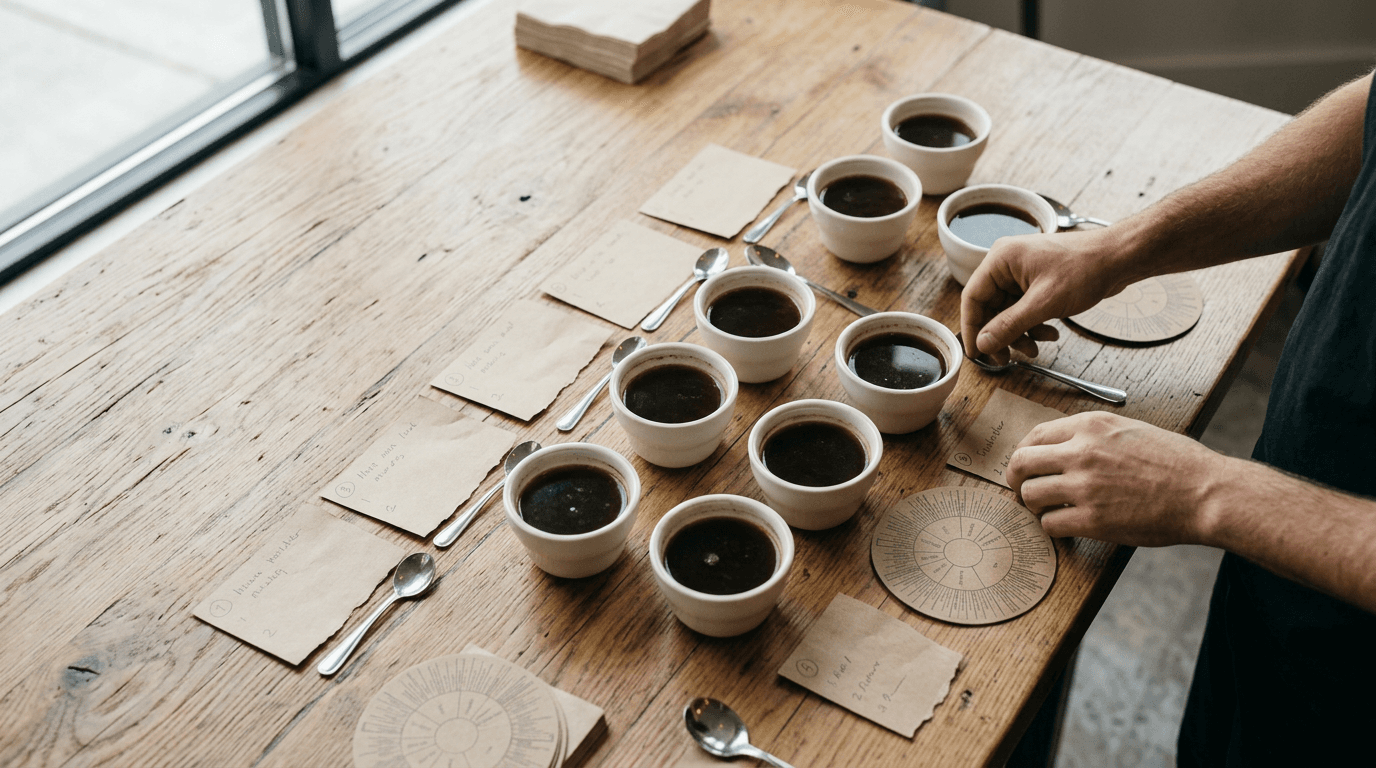
The mechanism requires a standardized sensory isolation process. The host prepares three or more distinct origins side-by-side using identical grind sizes, water temperatures, and steeping times in identical bowls. Participants use a spoon to break the crust of the grounds, slurp the liquid to aerate it across the tongue, and score the acidity, body, and finish on a blank card. Utilizing assorted Sample Packs allows the host to introduce a wide variety of processing methods - like natural versus washed - without committing to bulk bags.
Palate isolation breaks brand loyalty and marketing bias
When the packaging is removed, drinkers are forced to reckon with what they actually taste rather than what they expect to taste. A brewer who claims to hate light roasts will frequently score an acidic, fruit-forward Ethiopian bean highly in a blind setting, simply because the preconceived bias of the label is absent. This isolation proves that many flavor preferences are dictated by brand loyalty rather than actual sensory feedback.
Practical rule: Always use a neutral palate cleanser like plain water or an unsalted cracker between slurps. Cross-contamination of highly acidic and heavily roasted profiles will destroy the tongue's ability to differentiate the final bowls.
Blind tasting falls apart without strict environmental precision. If the water temperature drops between pouring the first and third bowl, the extraction rates will differ, invalidating the comparison. It also requires multiple brewing vessels and scales, making the cleanup highly tedious for a short sensory exercise.
Summary Table
| Activity | Primary Focus | Preparation Level | Social Dynamic | Best For |
|---|---|---|---|---|
| Structured Quiz | Theoretical Knowledge | High | Group | Testing industry facts and extraction metrics |
| Physical Art | Visual Aesthetics | Medium | Solo / Pair | Maximizing stale beans and milk texture |
| Digital Menus | Presentation | Medium | Pair / Group | Elevating the perceived value of home espresso |
| Talk Game | Social Connection | Low | Pair / Group | Breaking default autopilot communication |
| Intake Delay | Physiology | High | Solo | Managing chemical dependence and midday crashes |
| Blind Tasting | Sensory Palate | High | Solo / Group | Stripping away marketing biases and brand loyalty |
Where Each Routine Thrives
Selecting the right framework depends entirely on the bottleneck in your current routine. If your mornings feel rushed and disconnected, introducing prompt-based conversation cards forces a hard stop, utilizing the natural timer of a draining pour-over to mandate interaction. Conversely, if your technical knowledge has outpaced your actual palate, setting up a rigorous blind tasting flight forces you to re-calibrate your tongue without the crutch of reading tasting notes on a bag.
If you are attempting to mitigate a harsh afternoon crash, you must adopt the gamified delayed-intake schedule, mapping your cortisol levels and deliberately pushing the brew ritual back by 90 minutes. However, casual drinkers who simply want immediate comfort before starting a stressful commute should skip all of these formats entirely. Adding administrative overhead, strict rules, or complex cleanup to an already compressed morning will turn a reliable comfort into an aggravating chore.
FAQ
How many questions should a home brewing trivia night include? A standard session runs best with 20 to 30 questions broken into three distinct categories, such as history, processing methods, and extraction science. This keeps the event under an hour and prevents cognitive fatigue.
Can I use old beans for espresso painting? Yes, stale or poorly roasted beans are ideal for physical mediums. The chemical degradation that ruins the flavor profile does not impact the visual pigmentation once the liquid is boiled down into a viscous reduction.
How long should I wait before my first cup to avoid a crash? Physiological models suggest delaying intake by 90 to 120 minutes after waking. This allows natural cortisol to peak and clear residual adenosine from your receptors, preventing the compound crash that occurs when caffeine wears off mid-afternoon.