4 Burr Coffee Grinder Options for Perfect Extraction
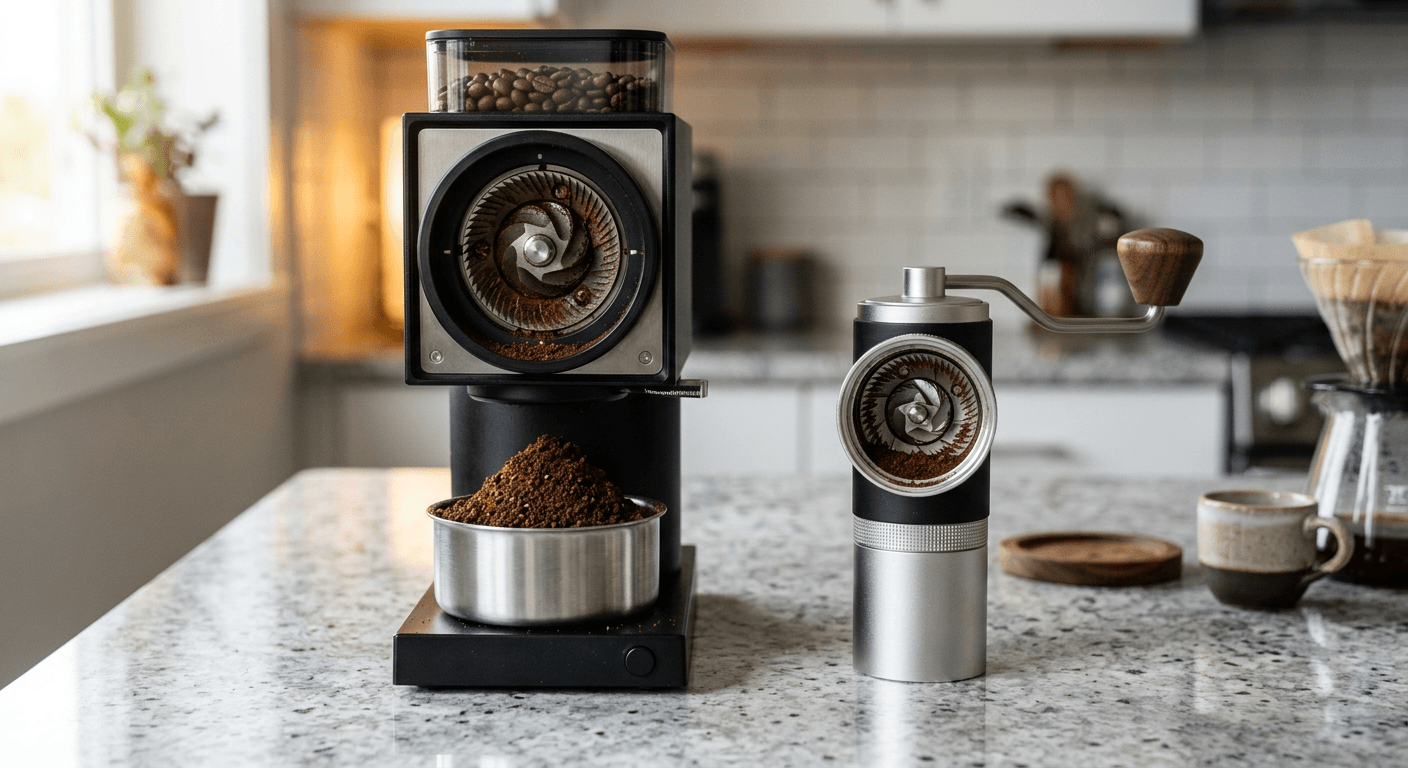
Many brewers assume a sour, astringent cup means the beans are stale, when the actual culprit is an inconsistent grind. Upgrading to a burr coffee grinder is the single most effective step a practitioner can take to control extraction yield. Chopping beans with a spinning blade creates a chaotic mix of boulders and fine dust. The dust over-extracts almost immediately, releasing harsh bitterness, while the larger boulders severely under-extract, contributing hollow, sour notes to the final cup. The permanent fix is moving to a mechanical system that crushes the beans precisely rather than chopping them blindly, dictating exactly how water interacts with the coffee bed.
Quick Summary
A burr coffee grinder crushes beans between two abrasive surfaces rather than chopping them with blades, ensuring the uniform particle size required for even extraction.
- Consistency directly controls flavor balance and prevents channeling.
- Burr geometry and motor torque dictate the effective grind profile.
- Manual options offer portability and eliminate heat transfer.
- Electric units provide consistency and speed for daily batch brewing.
Table of Contents
- Buying Guide / How to Choose
- 1. Fellow Opus Conical Burr Grinder
- 2. Baratza Encore
- 3. OXO Brew Conical Burr Coffee Grinder
- 4. Hario Mini-Slim+ Ceramic Coffee Mill
- Aligning Grind Capability With Your Routine
- Recommended Reads
| Product | Brewing Method Range | Features | Pros | Cons | Target Audience |
|---|---|---|---|---|---|
| Fellow Opus | Espresso to Cold Brew | Electric, all-purpose, dual-dial adjustment | Capable of espresso; broad range; fast workflow | Tedious micro-adjustments; not for commercial use; learning curve | Users needing full-spectrum brewing in tight spaces |
| Baratza Encore | Entry-Level Filter | Electric, 40mm steel conical burrs, stepped adjustment | Reliable low-RPM motor; intuitive hopper dial; great drip consistency | Cannot do espresso; wide adjustment steps; noisy plastic housing | Standard filter and immersion brewers |
| OXO Brew | Entry-Level Filter | Electric, stainless steel burrs, analog timer | Automates daily dosing; durable burrs; anti-static bin | Time-based dosing fluctuates; wide steps; retains stale grounds | Batch brewers prioritizing morning convenience |
| Hario Mini-Slim+ | Compact Manual | Hand-cranked, conical ceramic burrs, stepped nut | Prevents heat transfer; highly portable; completely silent | Requires significant physical effort; difficult to fine-tune; plastic shaft flexes | Travelers and off-grid single-cup brewers |
Buying Guide / How to Choose
Before evaluating individual machines, the lens to apply is the Brewing Method Range. A coffee bean grinder is engineered with specific burr geometries and motor torques that dictate how fine or coarse it can reliably grind. Trying to push a filter-focused machine into espresso territory usually stalls the motor or creates excessive friction, while using an espresso-focused machine for French press often results in too many fine particles muddying the cup.
We classify these options into three categories:
- Espresso to Cold Brew: Units with micro-step adjustments and high-torque motors capable of producing the fine, consistent particles required for pressurized extraction, while still accommodating coarser settings for cold water immersion.
- Entry-Level Filter: Machines optimized specifically for the middle of the grind spectrum. These handle drip, pour-over, and standard immersion brewing, but deliberately lack the precise micro-stepping needed to dial in espresso.
- Compact Manual: Hand-cranked devices designed for absolute portability and low-volume grinding, trading automated speed for an electric-free footprint.
Practical rule: Match the burr material to your expected daily volume. Stainless steel burrs cut sharply and last for hundreds of pounds of coffee, making them ideal for heavy daily electric use, while ceramic burrs resist heat transfer but take much longer to process beans, fitting low-volume hand grinding.
Dialing in the correct grind size is the only way to experience the intended flavor profile of complex Blends. Using the wrong category of grinder guarantees that either the machine will fail prematurely or the coffee will never extract correctly. The comparison below evaluates exactly where these proven machines succeed and where their capabilities stop.
1. Fellow Opus Conical Burr Grinder
Can one machine genuinely handle both morning drip and weekend espresso? Many buyers look specifically for a fellow coffee grinder that can cross this boundary without requiring two separate machines on the counter. The Fellow Opus Conical Burr Grinder is built to answer that directly. It operates as an electric all-purpose coffee grinder designed for grinding styles ranging from espresso to cold brew.
The Opus relies on a high-torque motor. It drives a 40mm conical burr set with a unique, two-stage adjustment mechanism. Instead of a single adjustment collar, it uses an outer macro adjustment ring combined with an inner micro-adjustment dial located under the load bin. This mechanism actually moves the outer burr closer to the inner cone in minute increments. This tightens the exit path for the crushed beans. When preparing a demanding, dense roast like an African Espresso, the beans are fractured and sheared uniformly enough to create the dense puck resistance necessary for a nine-bar extraction without stalling the electric motor. Buyers looking for a versatile Espresso to Cold Brew grinder will utilize this micro-stepping capability, something single-purpose, filter-only machines lack. Opening the burrs completely allows the machine to cleanly fracture beans for cold brew without producing the fine dust that typically clogs coarse filters.
Wide range introduces adjustment complexity
The structural limit here is the dual-dial system itself. Because the fine-tuning micro-adjustments require removing the hopper lid and calculating the offset between the inner and outer rings, dialing in a new bag of beans is mechanically tedious. It requires a reference guide just to understand which way to turn the inner dial for a 10-micron shift. This rules out users who rapidly switch between pour-over and espresso on the same morning, as the back-and-forth resetting takes significant time. We would hold off on this if your daily routine demands instant, single-motion grind size changes without needing to consult an adjustment chart.
Purchase this unit if counter space is tight but your weekly routine spans the entire extraction spectrum.
Pros
- Capable of espresso-fine grinds.
- Broad range covers cold brew preparation.
- Electric operation speeds up workflow.
Cons
- Micro-adjustments require internal access.
- Not built for high-volume commercial runs.
- Dual-dial system has a steep learning curve.
2. Baratza Encore
The moment a brewer realizes pre-ground coffee goes stale before the bag is finished is the exact trigger that sends teams looking for the Baratza Encore. Engineered specifically for home brewing, this machine functions as an electric entry-level conical burr coffee grinder that focuses entirely on mid-range consistency.
Inside the chassis, an aggressive DC motor spins a 40mm steel conical burr against a stationary outer ring gear. The grind size is dictated by rotating the hopper itself, which threads the upper burr carrier up or down. As the beans feed downward through the burrs, they are broken into consistent, uniform fragments ideal for gravity-fed brewing. The motor is geared down to spin at roughly 550 RPM, which reduces the heat generated during the crushing process and prevents static buildup from spraying chaff across the counter. This gearbox reduction also ensures the beans do not shatter violently, minimizing the fine dust that typically stalls a paper filter. This precise calibration separates it from machines attempting to do everything, establishing it firmly as a dedicated Entry-Level Filter grinder. Testing a Best Sellers Sample Pack: 6Bean, Cowboy, Breakfast, Peru, Mexico, Bali through this unit reveals exactly how different origins behave when ground uniformly for a drip machine.
Specialization prevents espresso extraction
Where this machine hits its wall is at the fine end of the spectrum. The adjustment steps between each macro setting on the hopper are simply too large to dial in a pressurized espresso shot. If setting 8 pulls a 15-second gusher, setting 7 will likely choke an espresso machine entirely. This stops being enough for anyone planning to purchase a pump-driven espresso maker. We find this fits best when the user explicitly intends to stick to pour-over, auto-drip, or immersion brewing, and we would skip it entirely if your future plans involve a portafilter.
Choose this model when your primary daily consumption relies on standard filter brewing and you want proven mechanical reliability.
Pros
- Reliable low-RPM motor reduces heat.
- Hopper-driven adjustment is highly intuitive.
- Excellent consistency for drip brewing.
Cons
- Cannot produce espresso-fine grounds.
- Stepped adjustments limit fine-tuning.
- Plastic exterior housing amplifies motor noise.
3. OXO Brew Conical Burr Coffee Grinder
Morning workflows often stall when users have to manually weigh their beans before grinding, a bottleneck the OXO Brew Conical Burr Coffee Grinder bypasses with integrated timing. This unit is an electric coffee grinder equipped with stainless steel conical burrs and adjustable settings designed to streamline the journey from hopper to filter.
Unlike grinders that require the user to hold down a pulse button, this system relies on an analog timer dial paired with a start button. The user sets the dial to a specific number of seconds, and the machine runs the 40mm stainless steel conical burrs for exactly that duration before automatically shutting off. The burr set uses a direct-drive configuration to pull beans from the UV-blocking hopper and crush them into the stainless anti-static grounds bin below. Designed specifically as an Entry-Level Filter machine, the burr geometry is cut to minimize fines in the medium-coarse range, making it highly effective for batch brewing a Single Origin Favorites Sample Pack. The adjustable settings ring shifts the outer burr in distinct clicks. This locks the gap firmly in place. The timer handles the dosing volume.
Timed dosing drifts with bean density
The vulnerability of this workflow is the reliance on time rather than mass. Ten seconds of grinding a dense, light-roasted Ethiopian bean will yield a significantly different weight in the catch bin than ten seconds of grinding a brittle, dark-roasted Sumatran bean. This means the timer must be recalibrated every time you switch coffees. This machine is a poor fit for precision brewers who demand single-gram accuracy without reaching for a separate scale. What would make us hesitate is the step size; the clicks on the adjustment collar are broad, meaning you cannot make the micro-adjustments required to perfect a finicky pour-over recipe, and the internal chute often retains a gram of stale grounds overnight.
Select this grinder if convenience and automated morning batch brewing outweigh the need for strict, gram-perfect dosing.
Pros
- Timer dial automates daily dosing.
- Stainless steel burrs offer long-term durability.
- Integrated catch bin minimizes static mess.
Cons
- Time-based dosing fluctuates with bean density.
- Adjustment steps are too wide for precise tuning.
- Retains stale grounds in the lower chute.
4. Hario Mini-Slim+ Ceramic Coffee Mill
While automated electric models prioritize speed and set-and-forget convenience, the Hario Mini-Slim+ Ceramic Coffee Mill forces a tactile connection with the process. It is a compact manual hand coffee grinder featuring conical ceramic burrs, built entirely for travel and low-volume preparation.
The device abandons a motor in favor of a top-mounted hexagonal crank handle attached directly to the inner burr shaft. The user provides the torque, forcing the beans down into the conical ceramic burrs. Because ceramic does not conduct heat the way steel does, the burrs remain completely cool regardless of how long the grinding takes, protecting the volatile aromatics of the coffee. The grind size is manipulated via a stepped nut located under the burr carrier; tightening the nut pushes the inner burr up, closing the gap for a finer yield. Counting the clicks from a zeroed starting point allows you to return to previous settings. By removing the electrical tether entirely, this Compact Manual grinder allows users to easily throw it into a bag alongside an Enamel Mug for off-grid brewing. Since ceramic will not rust, the entire burr set can be disassembled and washed with water. It should never be compared to heavy countertop units designed for speed.
Manual torque severely limits volume
The harsh reality of this coffee mill is the sheer physical effort required to operate it. Cranking enough beans for a single cup of drip coffee can take upwards of two minutes. Attempting to grind fine enough for espresso is exhausting. It tests the durability of the plastic internal shaft. This effort rules out anyone brewing for a household of three or more people. I would hold off if your morning window is tight. The same applies if you lack the grip strength to hold the narrow chamber steady against the resistance of light-roasted beans.
Opt for this manual unit exclusively when portability and electrical independence are your absolute top priorities.
Pros
- Ceramic burrs prevent heat transfer to beans.
- Highly portable for off-grid travel.
- Eliminates motor noise entirely.
Cons
- Manual cranking requires significant physical effort.
- Stepped nut makes fine adjustments difficult.
- Plastic shaft can flex under heavy load.
Aligning Grind Capability With Your Routine
Choosing a coffee burr grinder solution comes down to identifying exactly what brewing methods you realistically employ on a daily basis.
For the Espresso to Cold Brew category, the flexibility to hit both extremes of the extraction spectrum requires complex burr geometry. The Fellow Opus handles this wide span, making it the right selection for a user whose kitchen sees a portafilter on Saturday and a French press on Monday, provided they are willing to navigate a dual-dial adjustment system.
If your routine falls cleanly into the Entry-Level Filter category, paying for micro-step espresso adjustments is a waste of capital. The Baratza Encore offers proven longevity for standard drip and pour-over, while the OXO Brew speeds up the morning line with its time-based dosing. Either machine serves gravity-fed brewing well, but neither should be pushed into the espresso realm.
When mobility overrides all other concerns, the Compact Manual category steps in. The Hario Mini-Slim+ trades sheer electrical speed for ultimate portability, fitting the exact profile of a traveler or camper who only needs to process 15 grams of coffee at a time and has the patience to crank it by hand.