5 Home Coffee Methods: French Press Coffee Maker and Beyond
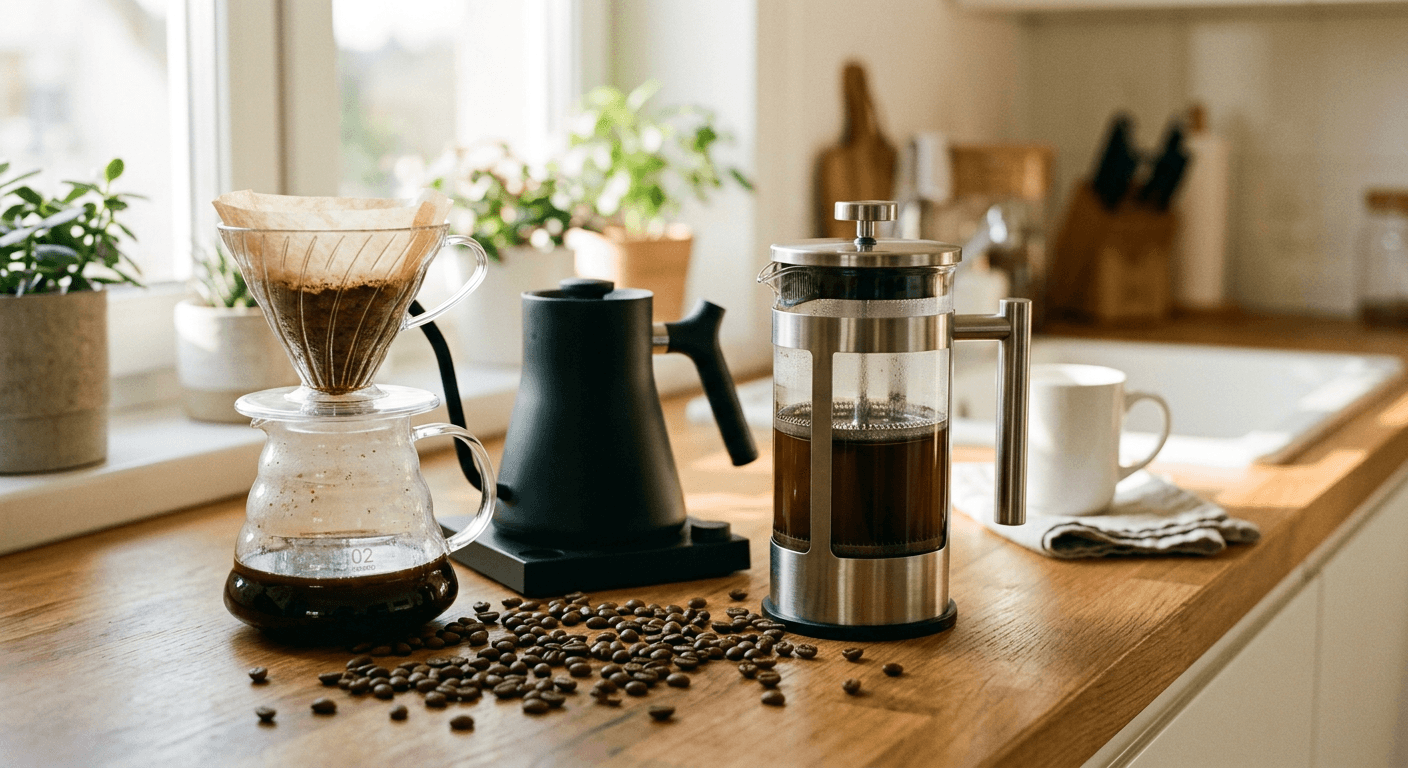
A french press coffee maker demands completely different extraction logic
You bring home a bag of specialty-grade beans, grind them, and dump them into a standard automated drip machine. The resulting cup tastes flat, thin, and nothing like what you drank at the local roaster. The problem is rarely the beans themselves. A french press coffee maker extracts entirely different chemical compounds from the exact same roast than a paper-filtered drip machine does. The lens for choosing home equipment is not a feature count or a digital display. It is understanding how the physical mechanics of immersion, percolation, and pressure manipulate the heavy oils and delicate acids hidden inside the roasted seed.
Quick Summary
Choosing the right home coffee setup comes down to matching the brewing physics with your daily routine and flavor preferences. By understanding how different water delivery systems alter the extraction of oils and acids, you can select equipment that actually suits your mornings.
- Immersion methods yield heavy body and rich texture but require decanting to prevent bitterness.
- Percolation tools produce bright, articulate cups by trapping oils in paper, though they demand active manual pouring.
- Pressurized extraction creates dense, syrupy concentrate rapidly but carries the highest barrier to entry in cost and skill.
- Cold extraction eliminates acidity entirely for a smooth profile, sacrificing origin complexity and requiring extensive foresight.
Table of Contents
- A french press coffee maker demands completely different extraction logic
- Quick Summary
- 1. French Press Coffee Maker
- 2. Pour Over Coffee Maker
- 3. Cold Brew Coffee Maker
- 4. AeroPress Coffee
- 5. Coffee Espresso Machine
- How Roast Levels Dictate Your Equipment Choice
- Which Brewer Fixes Your Specific Bottleneck
- Recommended Reads
| Method | Features | Pros | Cons | Target Audience |
|---|---|---|---|---|
| 1. French Press | Full immersion, heavy metal mesh screen, glass carafe | Extracts heavy body and rich texture without paper waste | Leaves silty residue and continues extracting if not decanted | Drinkers who prefer dark, heavily textured roasts |
| 2. Pour Over | Open-air percolation, conical geometry, thick paper filter | Produces high flavor clarity and highlights subtle floral notes | Demands continuous manual pouring and a specialized kettle | Drinkers who want bright, articulate light roasts |
| 3. Cold Brew | Extended ambient steeping, high-volume capacity | Creates incredibly smooth, low-acid liquid concentrate | Mutes complex origin characteristics and takes 24 hours | Drinkers seeking iced beverages or low-acid profiles |
| 4. AeroPress | Pneumatic pressure plunger, hybrid immersion chamber | Brews rapidly and cleans up in seconds | Strictly limited to brewing a single serving at a time | Solo drinkers, experimenters, and frequent travelers |
| 5. Espresso | 9-bar mechanical pump, tightly compacted grounds | Generates dense crema and heavy, syrupy concentrate | Intensely unforgiving and requires an expensive grinder | Enthusiasts willing to rigorously weigh inputs and outputs |
1. French Press Coffee Maker
A french press coffee maker is a cylindrical vessel equipped with a plunging rod and a tight metal mesh screen. It is built for drinkers who prefer a heavy, aggressively textured cup over a clean brew, and who want to prepare multiple servings simultaneously.
It relies entirely on full immersion brewing mechanics. You mix coarse coffee directly with hot water, allowing them to steep together in a static pool for four to eight minutes. Because the coffee remains in constant contact with the entire volume of water, extraction happens slowly and evenly across the dose. The critical component of this device is the metal mesh filter attached to the plunger. Unlike paper, woven metal does not trap the natural lipids and fine insoluble particles - known as fines - produced during grinding. These suspended oils and microscopic fragments pass directly into the final cup, providing the dense mouthfeel fundamentally associated with this method. The thermal mass of the heavy carafe also plays a significant role; preheating the vessel prevents the brewing environment from dropping in temperature too rapidly during the long steep, which would otherwise result in under-extracted, sour notes.
Metal filtration yields body at the cost of clarity
The extraction does not magically stop when you press the plunger down to the bottom. The spent grounds remain pinned beneath the mesh but are still submerged in hot water. If you leave the brewed coffee sitting in the vessel, it will continue to extract heavy tannins and bitter structural compounds, turning highly astringent within twenty minutes. You must decant the entire batch immediately after plunging. Furthermore, drinkers who despise a muddy, gritty residue at the bottom of their mug should skip this method entirely, as physical metal screens physically cannot filter microscopic particulates.
- Pros:
- Requires minimal pouring technique or active attention during the steep.
- Thick carafe walls maintain stable steeping temperatures for better extraction.
- Cons:
- Leaves an unavoidable silty residue at the bottom of every cup.
- Mandates immediate decanting to prevent over-extraction and aggressive bitterness.
2. Pour Over Coffee Maker
A pour over coffee maker is a manual dripping apparatus utilizing a conical or flat-bottomed geometry, a disposable paper filter, and a specialized pouring kettle. It serves drinkers who want a highly articulate, clean cup that distinctly highlights the nuanced acidity of specialty beans.
This equipment operates entirely via open-air percolation. Instead of soaking all the coffee in a static pool of water, you continuously pour a fresh stream of clean, hot water over a dry bed of grounds. Gravity pulls the water vertically down through the coffee, dissolving soluble mass as it travels. Because the water is constantly being replenished with fresh solvent, the extraction environment remains highly efficient and aggressive. The thick paper filter acts as an absolute physical barrier, absorbing heavy coffee oils and permanently trapping microscopic fines. This strict filtering process removes the compounds responsible for heavy texture, leaving behind a clear, visually translucent liquid that allows subtle, delicate tasting notes to dominate your palate without interference from bitter particulates.
Technique dictates the extraction rate
This method demands your undivided physical attention and rigid technique for three to four consecutive minutes. You cannot walk away while it brews. If you pour the water too aggressively, you agitate the coffee bed unevenly, causing the dense fines to migrate to the bottom and choke the paper filter, resulting in a bitter, stalled extraction. It also practically mandates the purchase of a specialized gooseneck kettle; attempting this procedure with a standard wide-spout kettle causes violent splashing that ruins the extraction geometry. Drinkers who require a passive, automated morning routine should look elsewhere.
- Pros:
- Paper filtration completely removes grit for a perfectly smooth texture.
- Allows precise control over water volume and extraction speed.
- Cons:
- Requires dedicated equipment like a gooseneck kettle to function properly.
- Prone to uneven extraction if your pouring technique is inconsistent.
3. Cold Brew Coffee Maker
A cold brew coffee maker is a high-capacity steeping vessel that completely replaces thermal heat with heavily extended time. It is engineered for drinkers who suffer from acid reflux, or who simply want to keep a smooth, highly concentrated iced beverage on hand in the refrigerator.
The equipment utilizes ambient or chilled water to extract soluble mass over an extended period - typically 12 to 24 hours. Because the water is cold, the basic extraction physics change dramatically. Hot water acts as an aggressive, rapid solvent, pulling out acidic and volatile aromatic compounds almost instantly. Cold water is a remarkably poor solvent for those specific organic acids, meaning they are largely left behind in the spent grounds. Instead, the prolonged steeping time slowly breaks down the complex sugars and heavier flavor compounds. The result is a dense, syrupy liquid concentrate with significantly lower titratable acidity than any hot-brewed counterpart. Once the long steep is finished, you filter the heavy concentrate through a coarse mesh or paper bag, storing the liquid to be diluted later with fresh water or milk.
Temperature removes acidity but flattens origin characteristics
The exact physical mechanism that makes cold extraction smooth also makes it structurally flat. High temperatures extract acidity, but acidity is what gives specialty coffee its bright, complex character. By brewing entirely cold, you permanently mute the articulate origin characteristics of a light roast. A floral, washed Ethiopian bean will taste almost identical to a dark, earthy Brazilian bean when subjected to this method. Additionally, the extreme time delay requires serious forward planning; you cannot wake up and decide you want this beverage if you did not start a batch the previous afternoon.
- Pros:
- Produces a naturally sweet, low-acid profile that is gentle on the stomach.
- Can be brewed in massive batches and stored for over a week.
- Cons:
- Obliterates the delicate floral and fruity notes of expensive light roasts.
- Demands 12 to 24 hours of waiting before the beverage is ready to consume.
4. AeroPress Coffee
An aeropress coffee brewer is a durable, syringe-like plastic polymer cylinder that combines brief static immersion with manual pneumatic pressure. It is the ideal instrument for travelers, solitary drinkers, and experimenters who demand a rapid, highly customizable cup without fragile glass components.
The process starts as a standard immersion brew. You mix medium-fine grounds with water in the main plastic cylinder and physically stir them to initiate extraction. Unlike traditional steeping, this static phase is incredibly short - often lasting just one to two minutes. The defining mechanism happens next: you insert a plunger equipped with a tight rubber gasket and physically push it downward. This action introduces positive pneumatic pressure, forcefully driving the liquid through a dense micro-filter paper cap at the bottom. The mechanical pressure physically forces the water through the dense cell walls of the coffee grounds, accelerating the extraction rate and pulling out complex flavors significantly faster than gravity alone could achieve. The resulting liquid sits somewhere between the bright clarity of a pour over and the concentrated strength of an espresso, though it lacks the sheer mechanical pump force required to produce true crema.
Pressure shortens the brew time and increases yield
The device is strictly limited by its physical volume capacity. The standard chamber holds a maximum of roughly 250 milliliters of water, making it an uncompromisingly single-serve instrument. Attempting to brew coffee for a table of four requires repeating the entire preparation, brewing, plunging, and cleaning sequence four separate times. Furthermore, the manual pressure required to plunge the device can be surprisingly demanding, requiring downward leverage that is entirely unsuited for individuals with wrist mobility issues or weak grip strength.
- Pros:
- Highly versatile design allows for thousands of different brewing recipes.
- Polymer construction makes it practically indestructible for travel.
- Cons:
- Limited water capacity makes brewing for multiple people an exhausting chore.
- Plunging mechanism requires significant physical force and leverage to operate.
5. Coffee Espresso Machine
A coffee espresso machine is a heavy mechanical or semi-automatic appliance designed to brew highly viscous, intensely concentrated shots rapidly. It caters to drinkers who want to replicate cafe-style textured milk drinks at home, or who prefer heavy, syrupy black coffee over large volumes of filtered drip.
True espresso operates on the strict principle of extreme, regulated mechanical pressure. Water is heated to precisely 200 degrees Fahrenheit by an internal boiler and then driven by an electric pump at a staggering 9 bars of pressure - roughly 130 pounds per square inch. This highly pressurized water is forced through a tightly compacted puck of microscopic, ultra-fine coffee grounds held in a heavy metal portafilter basket. Because the liquid has almost nowhere to go, it forcibly dissolves the cellular structures of the beans, violently emulsifying the natural oils and rapidly extracting soluble mass in under thirty seconds. This aggressive emulsification creates crema, the dense golden foam that caps a properly extracted shot. Achieving this delicate flow rate requires matching the exact physical resistance of the tamped coffee bed to the sheer force of the mechanical pump.
The pump mechanism requires precise physical calibration
The financial and educational barriers to entry for this equipment are immense. The machine is functionally useless without an equally expensive, micro-adjustable burr grinder capable of producing uniform, powdery fines. The brewing process is intensely unforgiving; missing your target by a single gram of mass or three seconds of flow time turns the shot into sour battery acid or bitter ash. You cannot mask stale, poorly roasted beans here. Freshly roasted, heavy-bodied profiles like African Espresso are mandatory, as older beans simply cannot provide the structural resistance the water pump requires. If you refuse to constantly adjust dial settings and weigh your outputs on a gram scale, this machine will produce consistently terrible results.
- Pros:
- Extracts an unparalleled concentration of heavy oils and intense flavors.
- Provides the necessary foundation for authentic cappuccinos and lattes.
- Cons:
- Carries an exceptionally high upfront cost for the machine and the mandatory grinder.
- Requires a frustrating, time-consuming learning curve to dial in the extraction.
How Roast Levels Dictate Your Equipment Choice
Buying a coffee brewing machine based purely on aesthetics ignores the most critical variable in your kitchen: the density of your chosen beans. The physical roast level of your coffee dictates how easily water can dissolve its flavor compounds, which directly determines which equipment will succeed.
Dark roasts are highly porous and physically brittle. Because the extended roasting process has already broken down their cellular walls, water extracts their heavy, chocolatey compounds almost instantly. If you subject dark roasts to long immersion times or extreme heat, they over-extract and turn aggressively bitter. They pair best with the rapid extraction of an AeroPress or the lower-temperature flexibility of cold brewers.
Conversely, light roasts are dense, hard, and stubbornly retain their acidic, floral compounds. Extracting them properly requires significant heat and mechanical agitation. A flat-bottomed percolation setup provides the aggressive solvent environment needed to break down those dense structures. Alternatively, if you prioritize theatrical presentation and absolute thermal stability, a vacuum-driven siphon coffee maker handles light roasts brilliantly, though it requires exhausting manual labor. If your household regularly drinks a wide spectrum of profiles - like the Best Sellers Sample Pack: 6Bean, Cowboy, Breakfast, Peru, Mexico, Bali - you should prioritize versatile percolation tools that allow you to adjust water temperature and pour speed on the fly. Avoid outdated tools like a traditional percolator coffee pot entirely; they brutally boil the brew and recirculate bitter liquid continuously over the beans, ruining both light and dark roasts alike.
Which Brewer Fixes Your Specific Bottleneck
If your primary morning bottleneck is pure volume, choose a large-format immersion tool or a high-capacity drip system. Pushing 40 ounces of water through a manual conical dripper will choke the paper filter, and pulling six consecutive highly pressurized shots will take twenty minutes of active, frustrating labor.
If your bottleneck is physical time at the kitchen counter, switch to cold extraction. Once the initial long steep is done the afternoon before, serving your beverage the next morning takes exactly ten seconds.
If your bottleneck is flavor clarity and you are tired of muddy, heavy cups that mask the origin notes of expensive specialty beans, transition to a paper-filtered percolation method. The active time required is a direct trade-off for physically stripping out the silty fines that ruin delicate floral profiles. Choose the tool that solves your most frustrating daily constraint, rather than the appliance with the most impressive feature list.